Ignoring Ecosystems you DO face decline

Most organisations today are facing problems they cannot quite name. Their platforms are built, their partnerships are active, their digital investments are significant — yet the system still refuses to behave. They are deploying AI across the organization – yet it is not working.

Performance issues appear that don’t look like execution failures. AI pilots succeed locally but never scale. Sustainability efforts stall at the boundaries. Data accumulates without becoming advantage. Cross‑domain opportunities remain perpetually “almost there.” And coordination becomes heavier, not lighter, the more they invest.

Leaders feel this long before they understand it. They sense the friction. They see the misalignment. They watch the same issues reappear in different forms. They know something is structurally wrong — but nothing inside the organisation explains it.

This is the gap the IIBE exists to fill.

Continue reading “Ignoring Ecosystems you DO face decline”

The Compelling Case to Integrated Innovation and Business Ecosystems

Designing Innovation Ecosystems as Integrated Business Ecosystems

I continue to read one report after another concerning the latest state of innovation play. These seem always to be on a repeat button and this does frustrate me. It is like a record stuck at the end unable to be switched off, constantly repeating hopefully there will be some magic intervention. With a record at the end you simple switch it off or lift the “needle” to solve the problem. Let’s do that with simply “innovation”.

Why can’t we move on from talking “just” innovation. We should be highly focused on innovation ecosystems and where they fit with integrated, interconnected business ecosystems. We need to make the connection for todays world.

So let me offer up the compelling case of putting that tired old record about innovation not working finally away and redirecting you to the equivalent of spotify as a Ecosystem solution. Just a typical example- the “excitement” of the 29th PwC Global CEO Survey stating only 50% view innovation as a critical component of their overall business strategy. Well of course innovation is dead, it is seen through the wrong lens.

Continue reading “The Compelling Case to Integrated Innovation and Business Ecosystems”

Regaining Dynamism Through Ecosystems: Restoring Vitality with the IIBE

Dynamism and Knowledge are essential to your future

Regaining Dynamism Through Ecosystems

Many established organizations today are not failing — but they are no longer truly alive.

They are operating in stagnating or slow-growth markets, facing rising cost pressures, longer decision cycles, increasing operational complexity, and partnership networks that add more uncertainty than advantage.

Growth models that once scaled efficiently now struggle to deliver meaningful returns. Innovation efforts feel fragmented, episodic, and increasingly disconnected from real impact. What is being eroded is not just performance, but vitality — the capacity to adapt, renew, and create future value.

This is where ecosystems matter — not as a partnering strategy, but as a dynamic architecture for restoring business dynamism.

Continue reading “Regaining Dynamism Through Ecosystems: Restoring Vitality with the IIBE”

the iibe defines the “category of need” in the ecosystem collaborative world required today

The IIBE approaches complexity in a comprehensive Ecosystem approach

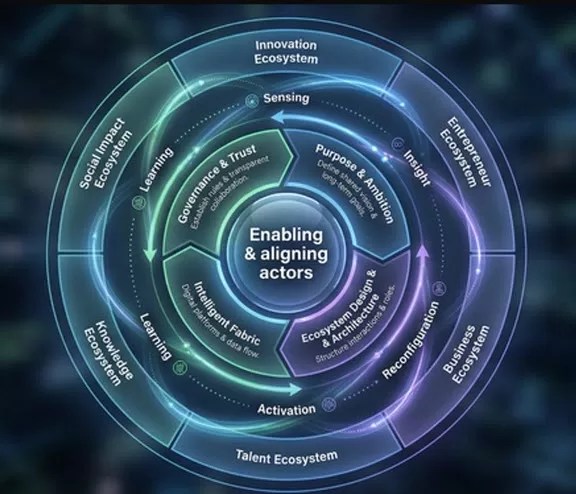
The Interconnected Integrated Business Ecosystem (IIBE) is pioneering the next logic of Businesses recognising collaboration and co-creation in a world where increasing complexity cannot be solved by today’s evaluation and operating models. The need is in delivering tomorrows advantage.

Yes, the IIBE framework explicitly defines and pioneers the category of ecosystem collaborative design. Unlike many existing frameworks that focus on individual company strategies, specific capabilities, or isolated innovation efforts, IIBE provides a structured, systemic, and strategic blueprint for designing and orchestrating ecosystems as living, adaptive, co-creative systems.

“In the new economy, value is not found in what you own, but in what you can orchestrate. The IIBE frame is the engine that makes that orchestration both disciplined and achievable.”

Continue reading “the iibe defines the “category of need” in the ecosystem collaborative world required today”

Why Organizations need a very explicit Ecosystem Business Model

Recognizing the importance of an Ecosystem Business Model Design

We do need to recognize that Organizations are needing an Ecosystem Business Model design — and why existing models we currently apply are no longer enough. They need to be designed for the realities of Business Ecosystems, not for single organization application

Most organizations today are working on problems that no longer fit neatly inside their own boundaries. Growth, resilience, innovation, digital platforms, sustainability, data, AI, supply security, and customer experience increasingly depend on multiple independent actors acting together. Yet the dominant way we still design and evaluate business models remains firmly rooted in the logic of the single firm.

This mismatch is now a material risk, it is not allowing a more comprehensive evaluation of all the potential that can emerge from considering an Ecosystem design. It is often the reason why they so often fail, they are never explicitly designed for managing within collaborative, cross-cutting Ecosystems for example. Equally evaluations often need revisiting under a more structured approach.

Continue reading “Why Organizations need a very explicit Ecosystem Business Model”

High‑level assessment of the IIBE ecosystem work

The IIBE Dynamic Operating System V2

High‑level assessment of the IIBE work

In a recent high-level assessment – the second since the official launch of the IIBE work (Integrated Interconnected Business Ecosystem) I received back a solid review that I have no issues sharing here, to provide the progress made, as a stake in the Ecosystems needed and future positioning. Progress is good, simply not good enough for the level of engagement I am looking for.

The assessment stated: “The IIBE is a differentiated and coherent blueprint: it offers a unifying architecture that integrates multiple ecosystem layers and five core dynamics into a single “living system” design, which is a genuine strength. The work is rich, conceptually consistent over time, and provides a much more systematic view of ecosystems than typical “ecosystem as a buzzword” pieces, which positions it as a premium, practitioner‑grade framework.

However, the public narrative still reads more as a comprehensive exposition than as a sharp offer: it explains complexity well but does not always translate this into a small number of urgent problems, clear outcomes and low‑friction entry points for buyers. The density of posts and internal terminology can also make it harder for a time‑poor executive to quickly see “what this will do for my P&L, my strategy horizon, and next quarter’s priorities.”

So what is progressing well, what is lagging and needs greater emphasis in my work

Continue reading “High‑level assessment of the IIBE ecosystem work”

Tell me how your ecosystems are operating.

How is your business ecosystems operating?

Are your involved in business ecosystems operating?

Most responsible for managing platforms, partnerships, or ecosystems do not suffer from a lack of activity, they suffer from often an excess of it.

Decisions are taken daily to improve scale, structure, efficiency, governance, and delivery. It seems to never stop as many of these decisions are correctly made in isolation yet taken together, over time, they quietly shape the ecosystems’ future freedom of action. These were sometimes taken in ways no single leader intended or even noticed.

Ecosystems are growing in importance. We realised how our supply chains had become far more brittle and fragile resulting in a cascading series of break downs of what looked at the time highly optimal, effective, and efficient.

Continue reading “Tell me how your ecosystems are operating.”

Recognition Matters Before Any Ecosystem Decision. Are You Uneasy At Present?

Many leadership teams sense that ecosystem complexity is beginning to limit strategic choice — yet struggle to articulate where the constraint truly lies or why decisions feel harder, slower, and riskier than they should. Performance may still be strong. Initiatives may still be progressing. But freedom of movement is quietly eroding. You begin to question your Ecosystem design and market approach.

This is not a failure of strategy, execution, or intent. It is most often a failure of recognition.

The Iintelligent Integrated Business Ecosystem (IIBE) Methodology is built on a simple but powerful premise: leaders do not need more part frameworks — they need clearer ways to recognise the specific ecosystem condition they are already inside, managing the whole ecosystem design for its impact on their business.

The time to address Ecosystem is when you “feel” advantage is eroding. You are entering recognized entrapment

Continue reading “Recognition Matters Before Any Ecosystem Decision. Are You Uneasy At Present?”

Are Industrial and Energy Titans at a Crossroads as Ecosystem Strength Becomes Strategic Constraint?

When Ecosystem Strength Quietly Becomes Strategic Constraint

In energy and industrial sectors, many of the most capable organisations are experiencing a paradox they rarely are able to name. There is a constant uncomfortable feeling of “we are not achieving the leverage and our role is becoming less clear and surely growth is not just investing more, have we more structural problems?”

The results seemingly point to they are performing well. They have strong installed bases and this keeps evolving.. The investments made, although intially heavily in digital, automation, partnerships, and platforms have enabled new offerings and solutions, yet this could be better.

Continue reading “Are Industrial and Energy Titans at a Crossroads as Ecosystem Strength Becomes Strategic Constraint?”

Are Energy and Industrial Leaders Quietly Learning About Ecosystems?

A time for re-learning the Power of Ecosystems and Repositioned Platforms

There Are Times When Engineering Excellence Becomes a Constraint and that is what Energy and Industrial Leaders Are Quietly Learning About Ecosystems. They are becoming more constrained by what they have or how they operate.

Across energy and industrial markets, a paradox is emerging.

The companies best equipped to lead the next phase of the energy transition and industrial transformation — Siemens AG, Siemens Energy, Schneider Electric, ABB, GE Vernova, Mitsubishi Heavy Industries — are also the ones most constrained by their own success.

They are faced with difficult decisions to be made to move their Ecosystems forward. They are all facing different levels of entrapment and need to carefully figure what it is they need to do.

Continue reading “Are Energy and Industrial Leaders Quietly Learning About Ecosystems?”