Why the IIBE Exists — Targeted, Executive‑Ready, and Industrial and Energy Company‑Specific

Building stronger Cross-Domain Structures

Why the IIBE Exists — For One Company Trying to Move Faster Than Its Ecosystem

Every industrial and energy company today is trying to accelerate — new business models, new digital layers, new partnerships, new transition pathways.

But acceleration keeps hitting invisible resistance:

  • partners who don’t move at your speed
  • customers whose ecosystems are more complex than your product logic
  • digital platforms that don’t scale across domains
  • regulatory shifts that destabilise plans
  • cross‑actor dependencies you don’t own or control

This isn’t because your strategy is wrong. It’s because you’re operating inside an ecosystem — but without an ecosystem architecture.

The IIBE exists for organisations like yours that need to:

  • align partners without owning them
  • scale digital and AI across boundaries
  • reduce friction in multi‑actor delivery
  • accelerate transition pathways without waiting for the whole sector
  • create coherence where the system is structurally misaligned

The IIBE doesn’t redesign the energy transition. It gives your organisation a structural way to move faster, align better, and collaborate more intelligently inside the transition you’re already part of.

Continue reading “Why the IIBE Exists — Targeted, Executive‑Ready, and Industrial and Energy Company‑Specific”

Why the IIBE Exists — Finance Specific, Targeted & Executive‑Ready.

The IIBE exists to manage your Ecosystem needs

Most financial institutions believe they already understand their ecosystem. Banks have partner networks. Fintechs have platforms. Payment providers have rails. Regulators have oversight. Identity systems have standards. Data networks have APIs. Cloud providers have integration frameworks.

On paper, it all looks connected.

But in reality, none of these actors share a common architecture — and the system behaves accordingly. You name them HSBC, BNP Paribas, Citi, UBS, ING, etc, same for the payments or FinTechs. They all have established Ecosystems but no structured collaborative architecture to change what we have today.

Continue reading “Why the IIBE Exists — Finance Specific, Targeted & Executive‑Ready.”

Siemens and the Dual-Force Model Is a great case study for building Ecosystems

Positioning the Dual-Force built with AI and IIBE within Siemens

Siemens are a great case study in validation about the need to apply a Dual-Force Model to building Ecosystems , yet also there are certain levels of caution in their next steps

This is a week (April 20th-24th) so critically important to Siemens and the Industrial Sector. This is the coming week for HANNOVER MESSE, the most important international platform and hot spot for industrial transformation

Siemens commits significant resources and budgets to this event this takes you to their navigation page to sign up and join in. It offers a “flagship” of their business. I gain enormous understanding of what is “internally” going in or in “selected” collaborations within the organization, in products, services, ideas and their approach to their markets.

They offer an immersive experience before, during and after the HM 2026 with their interactive Booth Navigator and a non-stop Stage Program where you can create your own experience and explore a daily stage program over five days packed with tech trends, industry insights and success stories.  You can watch this live on site, via stream or on demand.

One criticism of this HM2029 event from Siemens is they simply do not focus enough on the emphasis of Ecosystem management and what their Xcelerator platform can provide for their future growth, which is significantly more than at present in my opinion.

This is one case example where I would be wanting to understand where Siemens are in the Dual-Force Model. So let me offer this as a case study in validation and caution. They may not even recognize it as a growing problem for them! They need to.

This is about a 12 minute read so you might need to find the downtime to enjoy the read. Grab that coffee and lets go:

Continue reading “Siemens and the Dual-Force Model Is a great case study for building Ecosystems”

The Compelling Case to Integrated Innovation and Business Ecosystems

Designing Innovation Ecosystems as Integrated Business Ecosystems

I continue to read one report after another concerning the latest state of innovation play. These seem always to be on a repeat button and this does frustrate me. It is like a record stuck at the end unable to be switched off, constantly repeating hopefully there will be some magic intervention. With a record at the end you simple switch it off or lift the “needle” to solve the problem. Let’s do that with simply “innovation”.

Why can’t we move on from talking “just” innovation. We should be highly focused on innovation ecosystems and where they fit with integrated, interconnected business ecosystems. We need to make the connection for todays world.

So let me offer up the compelling case of putting that tired old record about innovation not working finally away and redirecting you to the equivalent of spotify as a Ecosystem solution. Just a typical example- the “excitement” of the 29th PwC Global CEO Survey stating only 50% view innovation as a critical component of their overall business strategy. Well of course innovation is dead, it is seen through the wrong lens.

Continue reading “The Compelling Case to Integrated Innovation and Business Ecosystems”

Why Organizations need a very explicit Ecosystem Business Model

Recognizing the importance of an Ecosystem Business Model Design

We do need to recognize that Organizations are needing an Ecosystem Business Model design — and why existing models we currently apply are no longer enough. They need to be designed for the realities of Business Ecosystems, not for single organization application

Most organizations today are working on problems that no longer fit neatly inside their own boundaries. Growth, resilience, innovation, digital platforms, sustainability, data, AI, supply security, and customer experience increasingly depend on multiple independent actors acting together. Yet the dominant way we still design and evaluate business models remains firmly rooted in the logic of the single firm.

This mismatch is now a material risk, it is not allowing a more comprehensive evaluation of all the potential that can emerge from considering an Ecosystem design. It is often the reason why they so often fail, they are never explicitly designed for managing within collaborative, cross-cutting Ecosystems for example. Equally evaluations often need revisiting under a more structured approach.

Continue reading “Why Organizations need a very explicit Ecosystem Business Model”

Ecosystem Blind Spots — What Organisations Can No Longer See

The multiple Ecosystem blind spots faced by Organisations

One of the most dangerous risks organisations face today is not competition, disruption, or even uncertainty. It is what they can no longer see.

As value creation, resilience, and innovation increasingly move beyond organisational boundaries, many leadership teams are still operating with organisation‑centric sightlines. The result is a growing set of ecosystem blind spots — areas where exposure accumulates quietly until it suddenly becomes unavoidable.

This is not a failure of intelligence or effort.. It is a failure of fit between how organisations are governed and how their world now actually works. It is a potetial strategic gap needing to be narrowed and understood.

What Are Ecosystem Blind Spots?

Continue reading “Ecosystem Blind Spots — What Organisations Can No Longer See”

High‑level assessment of the IIBE ecosystem work

The IIBE Dynamic Operating System V2

High‑level assessment of the IIBE work

In a recent high-level assessment – the second since the official launch of the IIBE work (Integrated Interconnected Business Ecosystem) I received back a solid review that I have no issues sharing here, to provide the progress made, as a stake in the Ecosystems needed and future positioning. Progress is good, simply not good enough for the level of engagement I am looking for.

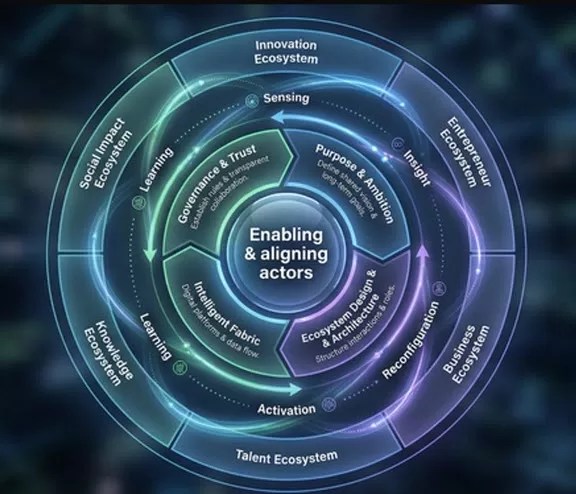
The assessment stated: “The IIBE is a differentiated and coherent blueprint: it offers a unifying architecture that integrates multiple ecosystem layers and five core dynamics into a single “living system” design, which is a genuine strength. The work is rich, conceptually consistent over time, and provides a much more systematic view of ecosystems than typical “ecosystem as a buzzword” pieces, which positions it as a premium, practitioner‑grade framework.

However, the public narrative still reads more as a comprehensive exposition than as a sharp offer: it explains complexity well but does not always translate this into a small number of urgent problems, clear outcomes and low‑friction entry points for buyers. The density of posts and internal terminology can also make it harder for a time‑poor executive to quickly see “what this will do for my P&L, my strategy horizon, and next quarter’s priorities.”

So what is progressing well, what is lagging and needs greater emphasis in my work

Continue reading “High‑level assessment of the IIBE ecosystem work”

Tell me how your ecosystems are operating.

How is your business ecosystems operating?

Are your involved in business ecosystems operating?

Most responsible for managing platforms, partnerships, or ecosystems do not suffer from a lack of activity, they suffer from often an excess of it.

Decisions are taken daily to improve scale, structure, efficiency, governance, and delivery. It seems to never stop as many of these decisions are correctly made in isolation yet taken together, over time, they quietly shape the ecosystems’ future freedom of action. These were sometimes taken in ways no single leader intended or even noticed.

Ecosystems are growing in importance. We realised how our supply chains had become far more brittle and fragile resulting in a cascading series of break downs of what looked at the time highly optimal, effective, and efficient.

Continue reading “Tell me how your ecosystems are operating.”

Recognition Matters Before Any Ecosystem Decision. Are You Uneasy At Present?

Many leadership teams sense that ecosystem complexity is beginning to limit strategic choice — yet struggle to articulate where the constraint truly lies or why decisions feel harder, slower, and riskier than they should. Performance may still be strong. Initiatives may still be progressing. But freedom of movement is quietly eroding. You begin to question your Ecosystem design and market approach.

This is not a failure of strategy, execution, or intent. It is most often a failure of recognition.

The Iintelligent Integrated Business Ecosystem (IIBE) Methodology is built on a simple but powerful premise: leaders do not need more part frameworks — they need clearer ways to recognise the specific ecosystem condition they are already inside, managing the whole ecosystem design for its impact on their business.

The time to address Ecosystem is when you “feel” advantage is eroding. You are entering recognized entrapment

Continue reading “Recognition Matters Before Any Ecosystem Decision. Are You Uneasy At Present?”

Providing Client Solutions for Business Ecosystems – IIBE related

Client Solutions for the Integrated Business Ecosysten (IIBE)

I am being asked how I structure my IIBE offering in a commercial structure to offer a clear pathway for potential clients. These are evolving as more modules are coming on stream or currently “in the works” as being validated.

The Key in my approach is to offer A modular, flexible commercial structure enabling tailored pathways for clients at different ecosystem maturity levels.

The designing principle of the Core Commercial Logic

The IIBE commercial model is built as a progressive pathway, allowing clients to enter at different points depending on maturity, ambition, and urgency. All offerings align to four principles:
(1) Low-friction entry points
(2) Capability-building progression
(3) Implementation support
(4) Ongoing advisory and intelligence renewal

Every module is independent but connects into a broader arc of ecosystem capability formation.

Applicable from January 2026, subject to updates and change as portfolio of offers expands.

Continue reading “Providing Client Solutions for Business Ecosystems – IIBE related”