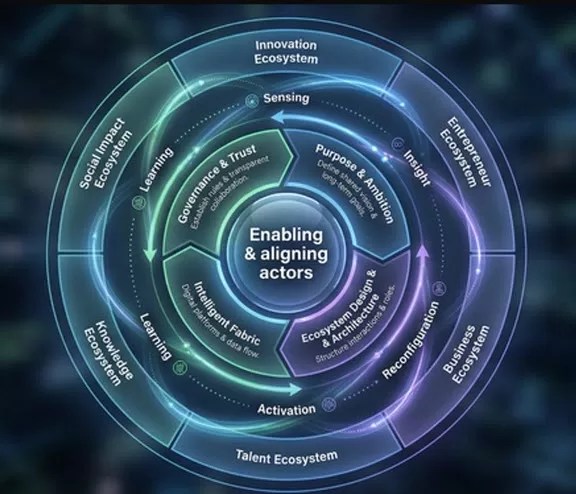
Emergence: Converting Ecosystem Intelligence into Knowledge and Value

From Flow to Knowledge provides New Emerging Value

Emergence occurs when we are converting Ecosystem Intelligence into Knowledge and Value

The architecture that breaks through the four invisible ceilings does not replace what organisations have built. It elevates it — transforming accumulated intelligence into flowing knowledge, that provides the new value that compounds with every actor the network touches making their contributions. We are achieving the power with Ecosystems

Emergence: Converting Ecosystem Intelligence into Knowledge and Value

It is not always visible when it happens. The investment continues. The partnerships are active. The platforms are performing. The AI is deployed. And somewhere in the gap between what the ecosystem is producing and what the original ambition implied it would produce, a different question begins to form — not how do we do this better, but what does this become when it is designed differently.

This is the third part of a three part series : From Flow to Knowledge: Moving Ecosystem Intelligence into Value

This post three delivers the architectural answer — the transition from accumulation to flow, fusion as what flow makes possible, the Living Bridge as the institutional function that holds dynamic orchestration and adaptive governance together, and emergence as what becomes possible when the design is right. Closes with the invitation rather than the prescription.

Here we explore what the Sensing-Meaning-Flow diagnoses within the ceilings that are presently stopping an organisation to “break through” and build new value. Applying a sequence of Flow-Fusion-Emergence breaks through it and converts what was stalling into compounding knowledge value. What emerges converts Intelligence into Knowledge and new Value that looks to Compound.

This sits within the beating core of the IIBE framework, its intelligent engine

Continue reading “Emergence: Converting Ecosystem Intelligence into Knowledge and Value”

The Architecture That Changes Everything in Ecosystems is Dynamic and Adaptive

The combination effect of Dynamic Orchestration and Adaptive Governance

The $50M+ Ecosystem Trap: Why Value Stops Compounding

Ask almost any enterprise executive managing a platform or partner network today, and you will hear a variation of the same frustrating question:

“We built the platform, secured the partnerships, and connected the data—so why isn’t the value compounding the way we expected?”

The answer isn’t a lack of effort or investment. It is a structural misalignment: Your governance is static, so your network cannot be dynamic.

Just pause and think about this: “Coordination is the management of known relationships toward known outcomes… Orchestration is the design of conditions under which actors create value that was not specifically directed or known”

Difference Between Managing a Network and Evolving One

Most organisations managing partner networks are coordinating brilliantly and calling it orchestration. But there is a massive structural difference between the two:

  • Coordination manages known relationships toward known outcomes. It optmises what exists, but it hits an invisible ceiling.
  • Orchestration creates the conditions where unknown actors discover each other and generate unexpected value that no central manager directed.

If you govern an ecosystem using static, calendar-based rules designed for linear partnerships, you choke off the very emergence that makes ecosystems valuable. This offers one of the clearest, most practical explanations of ecosystem failure in business understanding today.

Continue reading “The Architecture That Changes Everything in Ecosystems is Dynamic and Adaptive”

The Four Invisible Ceilings: Why Ecosystem Intelligence Stops Moving

Breaking through the invisible ceiling with Ecosystem thinking

AI Is Supercharging Your Acceleration—And Driving You Headfirst Into a Wall or a Ceiling

Right now, major enterprises are pouring unprecedented capital into AI and digital transformation. Execution is faster than ever. Algorithms are sharper than ever.

Yet, despite this massive injection of velocity, executive teams are noticing a alarming paradox: The spending is skyrocketing, but the compounding value has stopped.

AI isn’t solving the growth problem—it is acting as a supercharger that delivers your organisation to structural brick walls or concrete ceilings faster than ever before. In my research across leading global enterprises, these roadblocks aren’t operational mistakes you can plan around; they are Four Invisible Ceilings built into your legacy operating model.

What are those 4 Barriers that are silently killing Enterprise Growth?

When an enterprise attempts to scale beyond its own boundaries without an ecosystem architecture, it inevitably hits one of four ceilings:

  1. The Velocity Illusion: Moving fast on digital initiatives while making zero structural progress.
  2. The Intelligence Plateau: Amassing mountains of data and AI capabilities that remain trapped in isolated silos.
  3. Governance Inertia: Applying rigid, calendar-driven rules to dynamic, multi-partner networks.
  4. Capital Erosion: Watching transformation budgets dissipate through friction rather than compounding into new value.

Are you hitting those invisible ceiling faster than ever?

My research shows that without a dedicated ecosystem architecture, these investments inevitably crash into one of four invisible ceilings.

Continue reading “The Four Invisible Ceilings: Why Ecosystem Intelligence Stops Moving”

Ecosystems Are the Real Shift

Ecosystems are becoming the Real Shift

The hunt for real, sustaining growth is changing in character. It comes increasingly from resolving complex problems through networks of collaborators — bringing diverse expertise together into solutions that compound and generate value that no single organisation could produce alone. Something fundamental has changed in how value accumulates, accelerates, and becomes difficult to displace once the architecture is set. Business ecosystems are that pathway.

This is not a new observation. But the clarity available to organisations approaching it today is genuinely new. The organisations that recognised this earliest moved into ecosystem logic before the logic was fully legible — absorbing write-offs, leadership changes, and strategic reversals as the cost of discovery. Some emerged with genuine structural advantage. Others retreated with expensive lessons. A few are still working out what they built.

Continue reading “Ecosystems Are the Real Shift”

Adding Fusion into the European Innovation Scaling Mix

The European Activation Curve for Scale to Fusion

I have been building out a series of IIBE Framework papers looking at how the European Union through its European Innovation Council (EIC), a major EU initiative supporting deep-tech startups and research, can move its new scaling mandate underpinned by deploying a recently announced Euro 5 Billion fund.

The EIC is the right institution for this. Not because it is the only EU institution with a scaling mandate, but because it is the only institution that already operates above the national interest level, already has portfolio-level visibility across node types, and is already at the moment — the first Scaleup Europe Fund investment tranche — when integrating this governance architecture is most effective. The extension of EIC’s remit from financing scale to governing the ecosystem conditions for scale is not a departure from its mandate. It is the logical completion of it.

I worked through four documents looking at a combination of ideas that look to challenge political geography and optimize functional architecture. We should look for imaginative ways for true ecosystems of capital, intelligence, connections and resources can flow freely to the points where that expertise is the strongest across Europe. We need to think beyond boundaries into optimized performance. Can we think differently across Europe when it comes to innovation, make our institutional flows stronger?

Continue reading “Adding Fusion into the European Innovation Scaling Mix”

Forget the Component Approach think Ecosystem Architecture

We need to invest in Ecosystem Architecture, it compounds value

Most organisations today are trying to move faster than the system they sit inside.
The slowdown isn’t execution — it’s structural.

They are operating inside ecosystems without an ecosystem architecture:
the missing layer that aligns capabilities, intelligence, and value creation across partners, portfolios, and products.

The Intelligent Integrated Business Ecosystem (IIBE) provides that architecture. It turns ecosystems from fragmented networks into intelligent, adaptive systems that can sense, learn, and coordinate — so strategy, capability, and value creation move together, not apart.

If you’re feeling the limits of the system around you, the IIBE makes those limits visible — and solvable.

The Structural Problem Modern Organisations Can’t See

Across every sector — energy, industry, logistics, healthcare, finance — organisations are trying to accelerate innovation, digital transformation, and new value creation.

Continue reading “Forget the Component Approach think Ecosystem Architecture”

The Architecture of Ecosystems — What It Actually Takes

The Architecture of Ecosystems

The Architecture of Ecosystems — Do you recognize what it actually takes?

Many Business Ecosystems are not as well designed as they can be. Often, we are at the problem recognition level. Do we ever go beyond this to recognize the architectural specificity is missing and this is essential.

Do you have a real sense of what that architecture actually consists of or why its categorically different from everything you have tried before?

You now recognize the problem. The system is resisting you. The tools you built were designed for a different world. The structural layer never emerged.

But recognition is not enough.

The question every leader reaches at this point is the same: what would it actually mean to have an ecosystem architecture — and what does one consist of?

That question deserves a precise answer. Not a framework. Not a methodology. An architectural answer.

Continue reading “The Architecture of Ecosystems — What It Actually Takes”

Cause and Effect: The Ecosystem Architectural Reading for Europe

Flow Form and Fusion are all required in Europe for successful Ecosystems

Seven of Europe’s most significant industrial leaders have written an open letter last week, Read it carefully ( provided at the end of this article) — not for its political framing, not for its diplomatic language — but for what it says beneath the surface. We do need to pay attention and we need to find solutions, both short term and long-term

It can become a pivotal moment in European Technology and Industrial businesses future.

These technology and industry leaders are not start-ups seeking support. These are not trade associations lobbying for advantage. These are the chief executives of companies that between them employ hundreds of thousands of people, anchor entire industrial ecosystems, and carry a significant share of Europe’s capacity to compete at global industrial scale.

They are saying, in public, that something structural is wrong.

A letter written by seven CEOs is not a policy request. It is a structural diagnosis attempting to become visible.

Continue reading “Cause and Effect: The Ecosystem Architectural Reading for Europe”

Siemens: an IIBE Evaluation of their Industrial Ecosystem

I have been researching and diagnosing Siemens AG by putting through them my IIBE architecture approach and diagnostic.

This second post discusses their growing orchestration gap and the possible paths beyond this, if of course, they recognize it and what it means.

In my first post “Siemens and the Dual-force are a great case study” I offered a view about the need to apply a Dual-Force Model to building Ecosystems , yet also there are certain levels of caution in their next steps offered in this case study on the power and value of the Dual-Forces of AI + Intelligent Integrated Business Ecosystem model (IIBE), my lens at looking at the evolution of Business Ecosystems.

I argued that while Siemens holds a dominant position at the intersection of digital and physical domains. They are well positioned in key frameworks such as digital twins serving as coordination mechanisms. Siemens can create a self-improving system that is structurally impossible for competitors to replicate.

The IIBE verdict on Siemens is they have built the most credible industrial ecosystem you can find in the Industrial sector. It has the data, the partners, the sector coverage, and the AI capability to be the Dual-Force Model at full realisation.

What Siemens has not yet built is the orchestration architecture that turns those ingredients into a self-improving, compounding intelligence system.

This post starts at addressing part of the issues to achieve this.

Continue reading “Siemens: an IIBE Evaluation of their Industrial Ecosystem”

Why Most Boards Can’t Govern What They Can’t See to Manage Ecosystem Growth

Achieving a Clear Ecosystem Business Model line-of-site at Board Room Level

Why are Ecosystem opportunities failing? It is not from poor execution, but from poor recognition, many potentially exciting collaborations never get out of the assessment gate, mostly stuck at Board level. They climb up to the Board and then suddenly they vanish or get rejected.

This is one of the biggest frustrations being face today on building Business Ecosystems and needs changing..

Walk into any boardroom today and mention “ecosystem strategy.” You’ll get nods of agreement, enthusiastic approval, and immediate pressure to move fast. Six months later, that same initiative is stalled, the team is frustrated, and the Board is quietly wondering what went wrong.

The problem isn’t the idea. It’s not even the execution. The problem is that Boards are approving ecosystem commitments without understanding what they’re actually committing to and these risks make them very uncomfortable to take. What if that can change?

Continue reading “Why Most Boards Can’t Govern What They Can’t See to Manage Ecosystem Growth”