Ecosystem Blind Spots — What Organisations Can No Longer See

The multiple Ecosystem blind spots faced by Organisations

One of the most dangerous risks organisations face today is not competition, disruption, or even uncertainty. It is what they can no longer see.

As value creation, resilience, and innovation increasingly move beyond organisational boundaries, many leadership teams are still operating with organisation‑centric sightlines. The result is a growing set of ecosystem blind spots — areas where exposure accumulates quietly until it suddenly becomes unavoidable.

This is not a failure of intelligence or effort.. It is a failure of fit between how organisations are governed and how their world now actually works. It is a potetial strategic gap needing to be narrowed and understood.

What Are Ecosystem Blind Spots?

Continue reading “Ecosystem Blind Spots — What Organisations Can No Longer See”

Reflecting on the Essence of Ecosystems

Recognizing how connected Business Ecosystems need to be

I was just reflecting on the reasons and importance of Ecosystems. I put this together a while ago in an extended chat but felt it was worth publishing as it validates a lot of the direction for my work and the Integratd Interconnected Business Ecosystem (IIBE).

Business Ecosystems are undervalued and often poorly used. The ability to bring together a collaborative network of partners working on a shared goal that has impact and value beyond the existing solution one organisation alone can deliver, has significant advantages to grow out and extend a business.

This introduces the essence of ecosystems:

Continue reading “Reflecting on the Essence of Ecosystems”

High‑level assessment of the IIBE ecosystem work

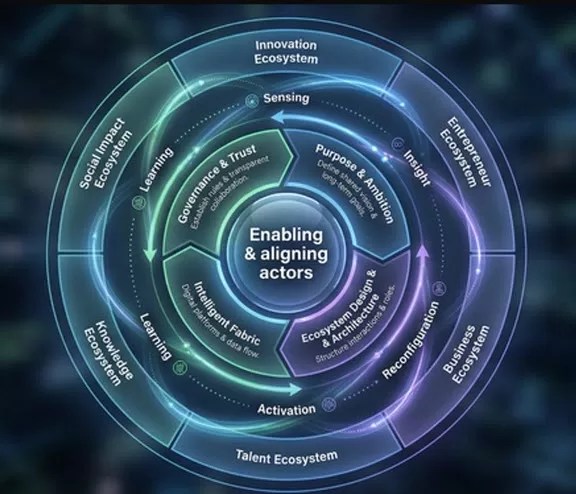
The IIBE Dynamic Operating System V2

High‑level assessment of the IIBE work

In a recent high-level assessment – the second since the official launch of the IIBE work (Integrated Interconnected Business Ecosystem) I received back a solid review that I have no issues sharing here, to provide the progress made, as a stake in the Ecosystems needed and future positioning. Progress is good, simply not good enough for the level of engagement I am looking for.

The assessment stated: “The IIBE is a differentiated and coherent blueprint: it offers a unifying architecture that integrates multiple ecosystem layers and five core dynamics into a single “living system” design, which is a genuine strength. The work is rich, conceptually consistent over time, and provides a much more systematic view of ecosystems than typical “ecosystem as a buzzword” pieces, which positions it as a premium, practitioner‑grade framework.

However, the public narrative still reads more as a comprehensive exposition than as a sharp offer: it explains complexity well but does not always translate this into a small number of urgent problems, clear outcomes and low‑friction entry points for buyers. The density of posts and internal terminology can also make it harder for a time‑poor executive to quickly see “what this will do for my P&L, my strategy horizon, and next quarter’s priorities.”

So what is progressing well, what is lagging and needs greater emphasis in my work

Continue reading “High‑level assessment of the IIBE ecosystem work”

The Release of the Intelligent Business Ecosystem 2026 Report

Intelligent Business Ecosystems Report 2026 connects the needed integration

In an era defined by volatility, complexity, confrontations and rapid technological acceleration, the traditional model of the isolated firm is becoming obsolete. Rigid linear value chains are failing to keep pace with the demand for speed, adaptability, innovation and sustainability.

To survive and thrive, organizations must transcend traditional buisiness silos and evolve into adaptive, resilient interconnected ecosystems

We are sensing the world is entering a decisive shift: in this case from platform-centric models towards fully dynamic, intelligent, coninuously orchestrated business ecosystems.

Continue reading “The Release of the Intelligent Business Ecosystem 2026 Report”

Tell me how your ecosystems are operating.

How is your business ecosystems operating?

Are your involved in business ecosystems operating?

Most responsible for managing platforms, partnerships, or ecosystems do not suffer from a lack of activity, they suffer from often an excess of it.

Decisions are taken daily to improve scale, structure, efficiency, governance, and delivery. It seems to never stop as many of these decisions are correctly made in isolation yet taken together, over time, they quietly shape the ecosystems’ future freedom of action. These were sometimes taken in ways no single leader intended or even noticed.

Ecosystems are growing in importance. We realised how our supply chains had become far more brittle and fragile resulting in a cascading series of break downs of what looked at the time highly optimal, effective, and efficient.

Continue reading “Tell me how your ecosystems are operating.”

Triggering Ecosystems with Progressive Learning

Ecosystems require a more dynamic, systematic approach to learning

It’s time to see beyond silos and embrace ecosystems as the future of innovation, resilience, and human progress. It is applying these triggers—Awareness, Mindset Shifts, Exploration, Design, Build, and Scale—to craft a pathway that over time moves from recognition to action, collaboration to impact. This is your roadmap. Now is the moment to lead the change.

Ecosystem design and learning are potentially very different from the way we operate within the one organization. So much has to be understood as different to”let go” and apply that Ecosystem thinking.

We need to recognize the comprehensive roadmap recommended below by using each of these triggers—scale, design, build, explore, awareness, and shifts in mindset—so they become the focal points for progressive learning and application within Ecosystem application.

Continue reading “Triggering Ecosystems with Progressive Learning”

Recognition Matters Before Any Ecosystem Decision. Are You Uneasy At Present?

Many leadership teams sense that ecosystem complexity is beginning to limit strategic choice — yet struggle to articulate where the constraint truly lies or why decisions feel harder, slower, and riskier than they should. Performance may still be strong. Initiatives may still be progressing. But freedom of movement is quietly eroding. You begin to question your Ecosystem design and market approach.

This is not a failure of strategy, execution, or intent. It is most often a failure of recognition.

The Iintelligent Integrated Business Ecosystem (IIBE) Methodology is built on a simple but powerful premise: leaders do not need more part frameworks — they need clearer ways to recognise the specific ecosystem condition they are already inside, managing the whole ecosystem design for its impact on their business.

The time to address Ecosystem is when you “feel” advantage is eroding. You are entering recognized entrapment

Continue reading “Recognition Matters Before Any Ecosystem Decision. Are You Uneasy At Present?”

Are Industrial and Energy Titans at a Crossroads as Ecosystem Strength Becomes Strategic Constraint?

When Ecosystem Strength Quietly Becomes Strategic Constraint

In energy and industrial sectors, many of the most capable organisations are experiencing a paradox they rarely are able to name. There is a constant uncomfortable feeling of “we are not achieving the leverage and our role is becoming less clear and surely growth is not just investing more, have we more structural problems?”

The results seemingly point to they are performing well. They have strong installed bases and this keeps evolving.. The investments made, although intially heavily in digital, automation, partnerships, and platforms have enabled new offerings and solutions, yet this could be better.

Continue reading “Are Industrial and Energy Titans at a Crossroads as Ecosystem Strength Becomes Strategic Constraint?”

Are Energy and Industrial Leaders Quietly Learning About Ecosystems?

A time for re-learning the Power of Ecosystems and Repositioned Platforms

There Are Times When Engineering Excellence Becomes a Constraint and that is what Energy and Industrial Leaders Are Quietly Learning About Ecosystems. They are becoming more constrained by what they have or how they operate.

Across energy and industrial markets, a paradox is emerging.

The companies best equipped to lead the next phase of the energy transition and industrial transformation — Siemens AG, Siemens Energy, Schneider Electric, ABB, GE Vernova, Mitsubishi Heavy Industries — are also the ones most constrained by their own success.

They are faced with difficult decisions to be made to move their Ecosystems forward. They are all facing different levels of entrapment and need to carefully figure what it is they need to do.

Continue reading “Are Energy and Industrial Leaders Quietly Learning About Ecosystems?”

The uncomfortable truth about your ecosystem

Growing concerns within your Ecosystem

Many organisations today are surrounded by partners, platforms, alliances, and innovation initiatives — yet feel less strategically free than they did a few years ago.

Decisions take longer. Dependencies feel harder to unwind. Changing direction carries more friction than expected.

This isn’t a failure of leadership or ambition. It’s a signal that ecosystem exposure is accumulating quietly — often unnoticed until options start to narrow.

Continue reading “The uncomfortable truth about your ecosystem”