High‑level assessment of the IIBE ecosystem work

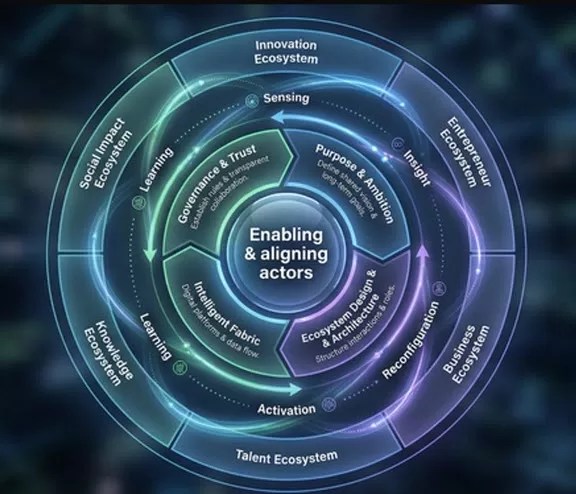
The IIBE Dynamic Operating System V2

High‑level assessment of the IIBE work

In a recent high-level assessment – the second since the official launch of the IIBE work (Integrated Interconnected Business Ecosystem) I received back a solid review that I have no issues sharing here, to provide the progress made, as a stake in the Ecosystems needed and future positioning. Progress is good, simply not good enough for the level of engagement I am looking for.

The assessment stated: “The IIBE is a differentiated and coherent blueprint: it offers a unifying architecture that integrates multiple ecosystem layers and five core dynamics into a single “living system” design, which is a genuine strength. The work is rich, conceptually consistent over time, and provides a much more systematic view of ecosystems than typical “ecosystem as a buzzword” pieces, which positions it as a premium, practitioner‑grade framework.

However, the public narrative still reads more as a comprehensive exposition than as a sharp offer: it explains complexity well but does not always translate this into a small number of urgent problems, clear outcomes and low‑friction entry points for buyers. The density of posts and internal terminology can also make it harder for a time‑poor executive to quickly see “what this will do for my P&L, my strategy horizon, and next quarter’s priorities.”

So what is progressing well, what is lagging and needs greater emphasis in my work

Continue reading “High‑level assessment of the IIBE ecosystem work”
Tell me how your ecosystems are operating.

How is your business ecosystems operating?

Are your involved in business ecosystems operating?

Most responsible for managing platforms, partnerships, or ecosystems do not suffer from a lack of activity, they suffer from often an excess of it.

Decisions are taken daily to improve scale, structure, efficiency, governance, and delivery. It seems to never stop as many of these decisions are correctly made in isolation yet taken together, over time, they quietly shape the ecosystems’ future freedom of action. These were sometimes taken in ways no single leader intended or even noticed.

Ecosystems are growing in importance. We realised how our supply chains had become far more brittle and fragile resulting in a cascading series of break downs of what looked at the time highly optimal, effective, and efficient.

Continue reading “Tell me how your ecosystems are operating.”

Recognition Matters Before Any Ecosystem Decision. Are You Uneasy At Present?

Many leadership teams sense that ecosystem complexity is beginning to limit strategic choice — yet struggle to articulate where the constraint truly lies or why decisions feel harder, slower, and riskier than they should. Performance may still be strong. Initiatives may still be progressing. But freedom of movement is quietly eroding. You begin to question your Ecosystem design and market approach.

This is not a failure of strategy, execution, or intent. It is most often a failure of recognition.

The Iintelligent Integrated Business Ecosystem (IIBE) Methodology is built on a simple but powerful premise: leaders do not need more part frameworks — they need clearer ways to recognise the specific ecosystem condition they are already inside, managing the whole ecosystem design for its impact on their business.

The time to address Ecosystem is when you “feel” advantage is eroding. You are entering recognized entrapment

Continue reading “Recognition Matters Before Any Ecosystem Decision. Are You Uneasy At Present?”

Providing Client Solutions for Business Ecosystems – IIBE related

Client Solutions for the Integrated Business Ecosysten (IIBE)

I am being asked how I structure my IIBE offering in a commercial structure to offer a clear pathway for potential clients. These are evolving as more modules are coming on stream or currently “in the works” as being validated.

The Key in my approach is to offer A modular, flexible commercial structure enabling tailored pathways for clients at different ecosystem maturity levels.

The designing principle of the Core Commercial Logic

The IIBE commercial model is built as a progressive pathway, allowing clients to enter at different points depending on maturity, ambition, and urgency. All offerings align to four principles:
(1) Low-friction entry points
(2) Capability-building progression
(3) Implementation support
(4) Ongoing advisory and intelligence renewal

Every module is independent but connects into a broader arc of ecosystem capability formation.

Applicable from January 2026, subject to updates and change as portfolio of offers expands.

Continue reading “Providing Client Solutions for Business Ecosystems – IIBE related”

A recommended client entry point within the IIBE for Business Ecosystem Building- Ecosystem Exposure

A client entry point recommended within the IIBE Offerings

Within my commercial model for client offerings, provided for Ecosystem building, thinking and design, the value of exploring Tier One as an initial low-cost investment is a great place to start. This extends the understanding of what lies under the IIBE hood, that fires and delivers your Ecosystem ambitions.

It provides some critical insights into how you could position your business for obtaining a competitive advantage at very low investments. You gain a highly valuable return for discovery, understanding and positioning of your Ecosystem.

Firstly Explaining The Overarching Commercial Logic

The IIBE commercial model is built as a progressive pathway, allowing clients to enter at different points depending on maturity, ambition, and urgency. All offerings align to four principles:
(1) Low-friction entry points
(2) Capability-building progression
(3) Implementation support
(4) Ongoing advisory and intelligence renewal

Every module is independent but connects into a broader arc of ecosystem capability formation.

My recommended starting point is:

Continue reading “A recommended client entry point within the IIBE for Business Ecosystem Building- Ecosystem Exposure”

Searching for the missing piece in modern Ecosystems

Recognising we need to see Ecosystems differently

The Gap Every Leader Feels—But Can’t Quite Name

We live in a world where:

  • markets move faster than planning cycles
  • partners change roles without warning
  • value shifts from inside the organisation to the ecosystem between organisations
  • customers behave across networks, not channels
  • regulators influence pathways in real time
  • technologies reshape boundaries overnight

Yet organisations are still run using:

  • static frameworks
  • linear planning
  • siloed intelligence
  • annual strategy
  • task-based AI

This creates a structural gap:

Leaders today are attempting to run a ecosystem design with tools designed for a stable organisation or world. They disappoint but it does not need to be that way

Continue reading “Searching for the missing piece in modern Ecosystems”

 The Urgent Need for Flexibility & Resilience through Energy Ecosystem Alliances.

Applying the IIBE Lens to the Grid Complexity to Trigger Collaboration

I believe there is a strong positioning proposal for forming an Intelligent Integrated Energy Ecosystem to confront the growing Grid Crisis.

Let’s Frame the Challenge– Across Europe, as well as the United States of America and multiple countries or regions globally, electricity grids are reaching structural limits

Increasing renewable penetration, growing electrification, distributed energy resources (DER), and the rise of prosumers have created a coordination problem of enormous complexity.

Continue reading ” The Urgent Need for Flexibility & Resilience through Energy Ecosystem Alliances.”

Choosing Dynamic Business Ecosystems? We actually need them

The IIBE Dynamic Operating System V2

The increasing pressure on business organizations to find real growth and impact is troubling. Expectations are growing with connected technology, the increased value from AI and the ability to collaborate all are requiring a different way to approach customers and provide radically new value opportunities.

Many of of existing organizations still operate with static operating models, hierarchical processes and siloed workflows. These modesl were built for predictability- not for complexity, interconnected markets, AI acceleration, or multi-party environments.

Today we are suffering from slower adaptation, fragmented intelligence, poor alignment across internal and external contributors, resulting in missed opportunities from this reluctance to collaborate, co-create or influence and shape markets beyond existing offerings.

What is necessary is to firstly explore why we need to shift to Ecosystems?

Continue reading “Choosing Dynamic Business Ecosystems? We actually need them”

An Executive Explainer of The Integrated Interconnected Business Ecosystem (IIBE)

Enabling and Aligning the IIBE Ecosystem approach

I wanted to provide a simple Executive Explainer on the The Integrated Interconnected Business Ecosystem (IIBE)

Background to the IIBE ModelExecutive Summary

The global business environment is entering a decisive shift: from platform-centric models to dynamic, intelligent, interconnected ecosystems. The convergence of AI-driven intelligence, orchestrated collaboration, micro-ecosystem structures, and regenerative purpose is reshaping how value is created, governed, and scaled.

The Integrated Interconnected Business Ecosystem (IIBE) provides the operating logic for this transition. This expainer outlines the key dynamics, design principles, and strategic pathways that will define the Intelligent Business Ecosystem era from 2026 to 2030.

In my opinion and for many others, Ecosystems are the necessary pathway all Business will need to consider and then travel for dealing in a complex, challenging world where closer more deliberate collaboration and co-creation will be needed, to solve more complicated problems that individual organizations will find it increasingly difficult to be able to solve these on their own .

In Seven Explaining parts this provides answers to key questions on the IIBE as an initial background briefing:

Continue reading “An Executive Explainer of The Integrated Interconnected Business Ecosystem (IIBE)”

Do not compare the IIBE Ecosystem blueprint with other well-regarded evaluation frameworks- its better!

There are several well-regarded frameworks for business ecosystems and digital transformation, but the Integrated Interconnected Business Ecosystem (IIBE) stands out for its comprehensive integration of multiple dimensions—strategic, operational, technological, governance, and societal impact—within a dynamic, adaptive architecture.

Other notable frameworks include:

  • Platform Ecosystem Models (e.g., by Geoffrey Parker, Marshall Van Alstyne): Focused primarily on digital platform economics, network effects, and governance but often less explicit on multi-layered integration and adaptive learning.
  • Business Model Canvas Extensions (e.g., Business Ecosystem Canvas): Provide visual tools for ecosystem mapping and value proposition but lack deep orchestration mechanics or AI-enabled dynamic adaptation.
  • Open Innovation and Collaborative Network Frameworks: Emphasize co-creation and external innovation sourcing but typically do not integrate governance, technology, and ecosystem dynamics as holistically as IIBE.
  • Digital Transformation Frameworks (e.g., BCG’s or McKinsey’s): Cover organizational change and technology adoption comprehensively but with less explicit ecosystem boundary and multi-actor orchestration focus.​

IIBE’s unique strength is its systemic, living architecture approach that explicitly integrates purpose, relationship, value, governance, and technology as co-evolving layers supported by AI-driven orchestration—making it one of the most holistic and actionable frameworks available today.

Continue reading “Do not compare the IIBE Ecosystem blueprint with other well-regarded evaluation frameworks- its better!”