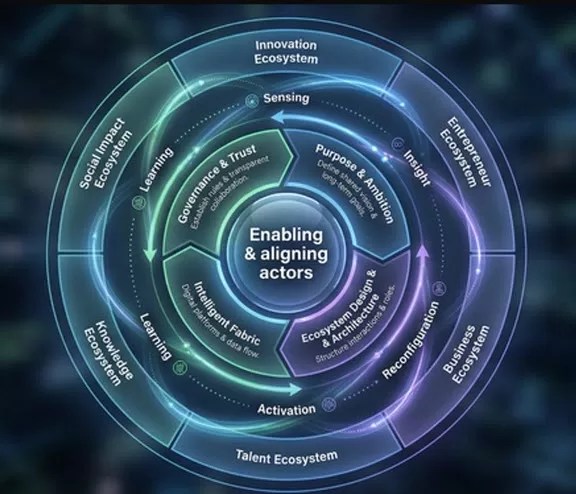
What happens when your Ecosystem shows signs of Collapsing- A Business Case Study of Northvolt AG using the IIBE Lens approach.

The IIBE Lens Business Case on Northvolt AG

We have not had the tools or comprehensive methodologies to find out what is happening when your Ecosystem shows signs of stress or even collapsing. In this Business Case Study of Northvolt AG using the IIBE Lens approach you can achieve this understanding.

Traditional analysis of the health of any Business Ecosystem can miss so much. In our constructing the Ecosystem IIBE Lens we found the Northvolt business case as a really revealing contrast case for the IIBE and how we learned to evolve it from this. We wanted to show what happened when the Ecosystem ignored the multiple signs of collapsing, and ask if these can be recognized as contributing symptoms earlier?

We believe we can provide the answers through the IIBE Lens

This post is part of a two week series where Week 1 established where the four industrial leaders sit today in their Ecosystem health; Week 2 shows what collapse looks like when the architecture fails in a specific case, Northvolt.

This post is an extended Business Case study of Northvolt AB- it provides some valuable lessons on the management of Ecosystems operating in complex, challenging and often volatile conditions rapidly seeking competitive advantage at speed and scale.

This is a 15-minute+ read as it offers an extended case study of the value of the use of the IIBE lens to a fascinating Ecosystem that showcases how to avoid or avert those moments when you can in your Ecosystem design cross thresholds where your operating logic must fundamentally shift and you realize the architecture has no mechanism to execute these shifts.

This case shows how seemingly a “healthy” ecosystem collapsed, what our original IIBE lens could see – in this case retrospectively- and what was missed, and introduces a new dynamic IIBE principle: designed for Ecosystem optionality under volatility.

Continue reading “What happens when your Ecosystem shows signs of Collapsing- A Business Case Study of Northvolt AG using the IIBE Lens approach.”

Optionality and Volatility in Industrial Ecosystems: How Leaders Need to Adapt and Compete

Optionality and Volatility in the IIBE Lens Ecosystem design.

Optionality and Volatility in any ongoing Ecosystem design is essential, It is critical to view and understand the risks you have and what might be building as operational and strategic issues.

How much of your current strategic freedom was actually designed- and how much is quietly being consumed? Does Enterprise Option Debt show up on your Balance Sheet? Ecosystems are very different in their management and what is so often lacking is the tools and methodologies of how to evaluate them. The IIBE blueprint and discussing here specifically the IIBE Lens can help overcome these doubts on assessing Ecosystems.

Here in my forth post the ability to assess optionality and volatility need a dedicated focus.

It is for this reason I separated this post within this short series on the value of using the IIBE lens to show how dramatically the evaluation of these two aspects of optionality and volatility can radically alter any Ecosystem assessment.

In today’s complex business environment, ecosystems are no longer static networks — they are living, adaptive systems subject to volatility and uncertainty. For industrial leaders like Siemens, GE Vernova, ABB, and Schneider Electric, understanding how to navigate these dynamics is critical for sustained advantage. What is emerging for each of them is a need for reviewing their strategic design for growing their business in the future. Navigating this is going to be tough and fraught with dangers and opportunities. A IIBE lens provides foresight.

Continue reading “Optionality and Volatility in Industrial Ecosystems: How Leaders Need to Adapt and Compete”

Is The Industrial Ecosystem Race Already Decided — Or Is It Still For the Taking?

The value of the IIBE Lens for Ecosystem Design

This is written more as a provocation showing the use the IIBE Lens for Ecosystem Management has hidden value . It can uncover uncomfortable truths.

Market conditions, sentiment and reaction to change can determine the longer term positioning for any organization. How well equipped are you to manage in more volatile times? Are you comfortable that your present Ecosystem design has flexibility and agility to adjust?

This post is to trigger thinking. It is written for executives who suspect that their current ecosystem narrative may not survive the next phase of industrial and energy-system change.

Introducing the IIBE Lens. In a series of four posts provided over on my other dedicated Ecosystem Design Hub site provided, is a focus on four of the most capable industrial companies in the world- and can potentially reframe how you read your own position. Applying your own IIBE Lens can certainly help.

In the four posts they are outlining the value of adopting an IIBE Lens you will see how different industrial and energy organizations are evaluated and assessed by using this approach through to positioning positions taken on Ecosystem offerings, to how optionality and volatility can radically alter propositions to impact their future.

Business ecosystems provide a real, sustainable and significant competitive advantage by shifting a company to a higher level of collaborative, networked value creation. Instead of just selling a single product, you are selling a “connected solution” built and supported by a web of partners, providing greater value and outcomes as a result.

Continue reading “Is The Industrial Ecosystem Race Already Decided — Or Is It Still For the Taking?”

Who Is Really Winning the Industrial Ecosystem Race?

Winning through the IIBE Lens Evaluation

Knowing where your Ecosystem approach “sits” relative to competitors needs a common comparable approach. You not only see where your own ecosystem is positioned but how it differs and very often being evaluated by partners and customers to understand differences to make their decisions to participate, engage or commit.

Most organizations are building or scaling ecosystems without a structured way to access whether their ecosystems are optimal or fit for growth and stress in changing market conditions.

By outlining in a short series a comparison of a selected group of Industrial giants and how they are managing their Ecosystem building you gain an understanding of what this IIBE Lens can provide.

Continue reading “Who Is Really Winning the Industrial Ecosystem Race?”

Why Most Boards Can’t Govern What They Can’t See to Manage Ecosystem Growth

Achieving a Clear Ecosystem Business Model line-of-site at Board Room Level

Why are Ecosystem opportunities failing? It is not from poor execution, but from poor recognition, many potentially exciting collaborations never get out of the assessment gate, mostly stuck at Board level. They climb up to the Board and then suddenly they vanish or get rejected.

This is one of the biggest frustrations being face today on building Business Ecosystems and needs changing..

Walk into any boardroom today and mention “ecosystem strategy.” You’ll get nods of agreement, enthusiastic approval, and immediate pressure to move fast. Six months later, that same initiative is stalled, the team is frustrated, and the Board is quietly wondering what went wrong.

The problem isn’t the idea. It’s not even the execution. The problem is that Boards are approving ecosystem commitments without understanding what they’re actually committing to and these risks make them very uncomfortable to take. What if that can change?

Continue reading “Why Most Boards Can’t Govern What They Can’t See to Manage Ecosystem Growth”

Comparing Industrial Ecosystem Strategies Through the IIBE Lens

Comparisons through the IIBE Lens for Ecosystem Opportunities

So the question here is “What the IIBE Lens reveals that Strategy reviews so often fail or miss in their assessments.” Ecosystems over time naturally build “tensions” progressively. The aim of the IIBE lens is to identify these tensions and gaps and assist management to recalibrate their Ecosystem in more dynamic ways to evolve.

Here, we are using the Intelligent & Integrated Business Ecosystem (IIBE) Lens to compare four global industrial leaders — Siemens AG, GE Vernova, Schneider Electric, and ABB — all of whom have been evaluated previously through IIBE informed analysis.

The IIBE is a diagnostic systematic approach designed to assess how well an organization is designed to operate, adapt and evolve through ecosystems, especially under changing market conditions. It seeks out tensions, gaps and opportunities that so often cannot be named but are giving cause to growing discomfort.

The intent here, in post two of this short series, is not to explain IIBE principles, but to focus on observable outcomes through what the IIBE lens offers: how each company positions its ecosystem, how attractive and usable those ecosystems are for customers and partners, the maturity of their platforms, and where gaps or constraints remain.

Continue reading “Comparing Industrial Ecosystem Strategies Through the IIBE Lens”

Looking Through the IIBE Lens: A New Perspective on Ecosystem Strategy

Looking through the IIBE Lens at Ecosystem Opportunities

A New Perspective on Ecosystem Strategy

Executives concern themselves with their Ecosystems, in design, in what they offer and the ability to gain the collaborations required to justify the investment and commitments. Often as a real concern is “Is your Ecosystem performing” That is exactly why you should be worried if you are unsure. Are your results masking and eroding your ecosystem fitness?

Discovering understandings of partner adoption attraction, the ability to assess if your orchestration costs are rising or actually being pushed down to clients, the actual platform engagement is it transactional rather than relational. So is your Ecosystem performing, what would a structured lens provide?

Business ecosystems provide a real, sustainable and significant competitive advantage by shifting a company to a higher level of collaborative, networked value creation. Instead of just selling a single product, you are selling a “connected solution” built and supported by a web of partners, providing greater value and outcomes as a result.

In this short series during this week I will be exploring the IIBE Lens, a way of explaining Ecosystems for organizations that provides an understanding of their maturity, health and appeal, as well as providing comparisons in their competitive field. It builds out different ecosystem approaches to show value, weakness and further opportunities, applying Ecosystem thinking and design applications.

Continue reading “Looking Through the IIBE Lens: A New Perspective on Ecosystem Strategy”

How the IIBE Delivers Measurable ROI Across Three Client Groups

Business leaders acknowledge that ecosystems are now critical to growth, innovation, and resilience, far fewer can answer a harder question:“What is the return on our ecosystem investments — and how do we know?”

The IIBE Delivers Measurable ROI Across Three different Client Groups Making Them Investable in returns and gains to advance your Ecosystem thinking.

The challenge is not a lack of activity. It is a lack of measurable clarity. Ecosystems are often positioned as strategic necessities but managed as experimental side initiatives, with limited visibility into value creation, decision confidence, or time-to-impact.

Continue reading “How the IIBE Delivers Measurable ROI Across Three Client Groups”

The Compelling Case to Integrated Innovation and Business Ecosystems

Designing Innovation Ecosystems as Integrated Business Ecosystems

I continue to read one report after another concerning the latest state of innovation play. These seem always to be on a repeat button and this does frustrate me. It is like a record stuck at the end unable to be switched off, constantly repeating hopefully there will be some magic intervention. With a record at the end you simple switch it off or lift the “needle” to solve the problem. Let’s do that with simply “innovation”.

Why can’t we move on from talking “just” innovation. We should be highly focused on innovation ecosystems and where they fit with integrated, interconnected business ecosystems. We need to make the connection for todays world.

So let me offer up the compelling case of putting that tired old record about innovation not working finally away and redirecting you to the equivalent of spotify as a Ecosystem solution. Just a typical example- the “excitement” of the 29th PwC Global CEO Survey stating only 50% view innovation as a critical component of their overall business strategy. Well of course innovation is dead, it is seen through the wrong lens.

Continue reading “The Compelling Case to Integrated Innovation and Business Ecosystems”

Why the IIBE Matters for Each Client Group we focus upon for Ecosystem Value

In today’s business environment, it has been suggested that more than 70 % of leaders struggle with ecosystem planning, understanding, or extracting value. Many initiatives stagnate in fragmentation, misaligned purpose or slow value pathways — because ecosystems are still treated as buzzwords rather than operating systems for adaptive competitive advantage.

The Integrated Interconnected Business Ecosystem (IIBE) is uniquely positioned to solve this exact problem: to help organisations diagnose their ecosystem health, implement structured pathways, and extract new value from their collaborative networks in practical, measurable ways.

Below is how each of our three principal client groups — Mature Ecosystem Leaders, Disruptors & Emerging Challengers, and Nascent/Laggards/Emerging Catalysts — we are suggesting how they should recognise the problem, what they need to value the most, and how a dedicated IIBE offering gives them confidence, coherence, and competitive edge.

Continue reading “Why the IIBE Matters for Each Client Group we focus upon for Ecosystem Value”