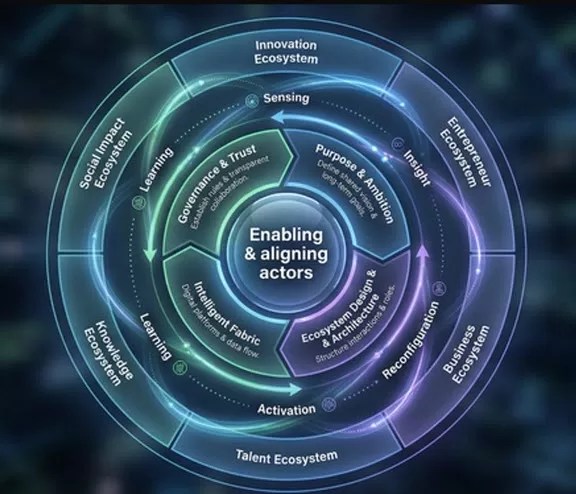
Client Solutions for the Integrated Business Ecosysten (IIBE)
I am being asked how I structure my IIBE offering in a commercial structure to offer a clear pathway for potential clients. These are evolving as more modules are coming on stream or currently “in the works” as being validated.
The Key in my approach is to offer A modular, flexible commercial structure enabling tailored pathways for clients at different ecosystem maturity levels.
The designing principle of the Core Commercial Logic
The IIBE commercial model is built as a progressive pathway, allowing clients to enter at different points depending on maturity, ambition, and urgency. All offerings align to four principles: (1) Low-friction entry points (2) Capability-building progression (3) Implementation support (4) Ongoing advisory and intelligence renewal
Every module is independent but connects into a broader arc of ecosystem capability formation.
Business Ecosystems, Platforms and the new Enterprise Framework
Is the world entering a decisive shift: from platform-centric models toward fully dynamic, intelligent, continuously-orchestrated business ecosystems. I believe so.
Economic advantage, innovation performance, and adaptive capacity will increasingly depend on an organization’s ability to operate within the Intelligent Business Ecosystem solution – systems defined by circulating intelligence, shared value creation, and human–AI collaboration at every level.
This will define competitive advantage in 2026–2030. It introduces the new intelligence fabric, explains the shifts we need towards a different approach to orchestration, combined as the new strategic differentiator
Integrated Business Ecosystems will become the dominant operating logic of the second half of the decade.
Siemens has announced a “new growth era,” fuelled by its One Tech ambition, disciplined capital allocation, and a sharpened portfolio. The message is “confidence with prudence” — a determination to grow, but within the lines of a proven industrial blueprint. Yet beneath this narrative lies a fundamental question:
To quote from the Press Release : “Siemens today (13th November 2025) presents its strategy for achieving the next stage of growth at the “Siemens ONE Tech – Strategy & Results” event.
“Siemens today is stronger than ever – with a record fiscal 2025. Our strategy works. We grow by combining the real and the digital worlds. With our ONE Tech Company program, we enter the next stage of growth and raise our mid-term ambition for revenue growth to 6 to 9 percent”, said Roland Busch, President and Chief Executive Officer of Siemens AG. “With a highly synergistic portfolio, we aim to double our digital business revenue, capitalize on growth regions and verticals, and scale our AI offerings with €1 billion investment over the next three years.” Siemens is raising its mid-term revenue growth ambition to a range of 6 to 9 percent, excluding Siemens Healthineers
As I was listening, I kept asking “are they leveraging and exploring ways to accelerate this further in additional ways of opportunity exploration?”
Is Siemens’ next wave of growth truly coming from the reuse of existing strategic levers — or does its real potential remain locked behind a management mindset, drawn from depth within the industres themselves, focused on technology enablement alone, and not necessarily from that external perspective to challenge and encourage them to shift , one that still favours central control over the additional ecosystem acceleration that might be worth reconsidering with some loosening up?
First, I have to acknowledge my admiration for Siemens
Siemens is an extraordinary enterprise with deep capabilities across Infrastructure, Mobility, and Digital Industries. It has unmatched breadth. It has an installed base that others envy. It has technology assets that genuinely connect the physical and digital worlds.
But it also suffers from a structural tension, that is not such a hidden secret: where a centrally orchestrated strategy trying to power divisions with radically different growth horizons, market dynamics, and ecosystem potentials gives this “creative tension”. That provides and generates potential but can also stifle differences that might offer a greater growth if constructued differently.
My thoughts here:
To move from industrial dominance to ecosystem leadership, Siemens must confront and resolve six strategic issues. Doing so would position it not simply as an engineering and technology giant, but as an orchestrator of next-generation, cross-industry value creation — the very space where the Integrated Intelligent Business Ecosystem (IIBE) becomes essential and clearly argued by me.
These suggestion or observations are strictly through my IIBE lens.
1. The Mindset Gap: From Portfolio Leverage to Shared Value Creation
Siemens’ current message — centred around portfolio strength, engineering excellence, and disciplined growth — reflects a given older century industrial mindset, not a 21st-century ecosystem one. Much as technology has become more central and Siemens future “bet”
Its “One Tech” ambition is internally coherent but externally limited. It frames Siemens as the anchor, the core, the provider of the enabling stack. That is not an ecosystem. They apply “platform thinknig” through their Xcelerator platform but struggle to turn this into a truly collaborative vehicle for growth, it remains simply one enabler or fascilitator
An ecosystem mindset requires:
Distributed advantage, not central dominance
Shared intelligence, not proprietary engineering first
Co-creation of value, not extraction from partners
Fluid roles, not defined ownership
Siemens’ communications still describe ecosystem engagement as ways to extend Siemens’ reach, leverage its portfolio, and amplify its digital services. This is linear value thinking — not systemic value creation.
This is where the IIBE lens exposes the gap. Ecosystems are not extensions of a portfolio; they are dynamic, co-evolving networks where intelligence emerges from relationships, not from control.
Unless Siemens shifts from “our portfolio at the centre” to “shared purpose and distributed value”, its ecosystem promise will remain undeveloped — and competitors more fluent in this logic will outpace it.
2. The Structural Constraint: A Centrally Driven Strategy in a Federated Organisation
Siemens’ biggest strength — its federated division structure — is also its biggest constraint. Each division has different growth dynamics, regulatory landscapes, partner networks, and maturity levels:
Infrastructure competes against Schneider Electric’s ecosystem-first positioning.
Digital Industries is still the core, but its growth curve is flattening, not steepening.
A centrally imposed “One Tech” strategy risks becoming a lowest-common-denominator framework. It stabilises the whole but accelerates none of the parts.
Ecosystems require differentiated autonomy:
Each division must be free to build its own ecosystem architecture, aligned with its markets.
Shared technology should enable — not constrain — ecosystem models built closest to customers.
Intelligence must flow across, not down through top-heavy structures.
The IIBE explicitly recognises this: future growth emerges from dynamic, nested ecosystems, not monolithic strategies. Siemens must loosen its centre — not dismantle it, but reframe it as an intelligent enabler, not an approval layer.
Can this be managed at a Management Supervisory board level. I belief so. The board moves to a Orchestrator role
3. The Market Reality: Infrastructure and Mobility Are the Ecosystem-Native Businesses, possibly constrained?
Two Siemens divisions are already deeply ecosystem-dependent:
Infrastructure
Competing against Schneider Electric, ABB, and Johnson Controls, value now emerges from:
Energy management platforms
Smart infrastructure services
Distributed grid orchestration
Whole-building digital twins
Regenerative, circular-energy ecosystems
Here, Schneider has taken the lead by positioning itself as an ecosystem orchestrator, while Siemens still positions itself as a technology integrator.
The difference is profound. It holds Siemens back
Mobility
Mobility operates in a world where no single actor can deliver anything alone:
Rolling stock
Rail infrastructure
Digital signalling
Urban mobility systems
New mobility orchestration platforms
Multi-modal city ecosystems
This is fertile territory for a next-generation ecosystem strategy, but Siemens continues to operate through programmatic partnerships, long sales cycles, and project-based integration.
Mobility could be Siemens’ breakout ecosystem engine — but only if it moves from selling systems to shaping mobility ecosystems.
4. The Growth Challenge: Digital Industries Cannot Be the Sole Accelerator
Digital Industries has been Siemens’ growth engine for a decade, it has driven the evolution and recognition of the value of connected technology but:
The automation market is maturing
Competitors (Rockwell, Emerson, Yokogawa) are catching up
New Chinese entrants are scaling rapidly
AI-native industrial startups are nibbling into high-value workflows
DI still matters hugely — but expecting it to drive the next 10 years of disproportionate growth is unrealistic. The options of M&A here are growing both incrementally to “plug portfolio gaps” but also to broaden the Digital Industries positioning
This is where ecosystems transform the trajectory:
DI must become the intelligent backbone of other division ecosystems
It should not simply “sell more software” but shape shared intelligence, data flows, governance models, and interoperability frameworks
It must power Infrastructure and Mobility, not just be one of three divisions
It is in the primium position of being the industry “super” Orchestrator
The promise of “connecting manufacturing” need collaboration and stronger alliances
This is aligned with the IIBE’s five dynamic lenses, especially mapping, intelligence building, and technology enablement.
5. The Strategic Missing Piece: A True Ecosystem Operating Model
Siemens talks partnerships. It talks networks. It talks collaboration. It is catching up here. It needs to accelerate its whole CRM momentum in cross-synegistic ways.
But it does not yet have an ecosystem operating model — the set of governance, data policies, roles, value-sharing mechanisms, and decision flows required for ecosystems to function so it can flow, form and function that give a more dynmaic operating logic, a structural architcture and providing the integrative intelligence where the human-AI orchestration gives synchrony .
The IIBE highlights that ecosystem success requires:
Mapping & diagnostics — understanding the dynamic ecosystem landscapes
Connectivity & alignment — building shared interfaces, data layers, and governance
Decision flow — enabling distributed choices, trust, and coherence
Learning & intelligence building — accelerating shared insights
Technology enablement — creating the digital backbone
Siemens today only strongly activates the fifth. The other four remain underdeveloped across the group.
Without an operating model, Siemens’ ecosystem narratives are conceptually attractive but practically limited.
6. The Growth Mindset Siemens Needs: From Control Logic to Emergence Logic
The final issue is the type of growth Siemens is building toward. We live in a very different, often conflicting and complex world. All of us are struggling on how to become more adaptive, more dynamic in how we see things, adapt and react. I feel Siemens is working hard on that
Siemens’ current orientation uses:
Portfolio leverage
Capital deployment discipline
Incremental digital expansion
Safe M&A adjacencies
Predictable long-cycle customer relationships
This is solid. It is prudent. But it is not exponential. Can it be? What can givea very different perspective?
The companies shaping the next industrial era — Schneider, NVIDIA, AWS, Bosch Mobility, Tesla, Enel, Hitachi Rail, Siemens Healthineers (ironically its own former sibling with a growing and different mindset due ot its needs) — operate with an emergence mindset:
Shared data → Shared advantage
Distributed intelligence → Better decision-making
Partner co-creation → Faster innovation cycles
Platform ecosystems → Pull, not push growth
System-level design → Value across categories
This is precisely what the IIBE was built to operationalise. The IIBE prehaps gives Siemens the missing mechanism for moving from:
Management logic → Ecosystem logic
Control → Coordination
Centralised design → Distributed co-evolution
Predictive planning → Dynamic sensing and response
This is in my opinion the mindset Siemens must adopt if its “new growth era” is to be more than a continuation of its old growth formula.
Conclusion: Siemens Has the Potential — But Must Choose the Mindset of tomorrow
Siemens is at a strategic moment. It has announced the spinning out of Siemens Healthineers to release capital appropriate to the organization’s belief of where its growth potential is. The three divisions left are all in need of a loosening up for individual persuit but in an overaching orchestrated way
Siemens AG offers incredible potentia
It has the technology.
It has the market reach.
It has the portfolio breadth.
It has the credibility and trust.
It has theproven portfolio of products that stand as best in class
What it lacks — and what it urgently needs — is:
A genuine ecosystem mindset
A division-specific ecosystem architecture
A dynamic operating model (the IIBE provides this)
A more distributed approach to innovation and growth
A shift from portfolio leverage to shared value creation
So in listening yesterday and reflecting on this I put on my IIBE lens and offer this. If Siemens addresses these six issues, it will not only unlock new growth — it will redefine what industrial value creation looks like in the next decade.
If it does not, it risks staying powerful but increasingly linear in a world that is becoming exponentially interconnected.
The choice lies in whether Siemens is willing to evolve its management logic — and embrace the ecosystem logic that will define its true future potential.
Business Ecosystems are interconnected and integrated to build unique value and greater resilience
How are you facing a changing, world defined by a growing volatility (VUCA)?
This LAUNCHES a definitive dynamic ecosystem blueprint focusing on the integrated concepts and frameworks I have been working on for the past 20 months. The research and design are providing a new architecture. It is distinctive and has many parts that will emerge in the next months.
Here I am introducing the solution concept to overcome and redefine how organizations can create superior value and drive innovation in more distinctive and radical ways in a more dynamic world we are facing today.
The approach using the Integrated Interconnected Business Ecosystem (IIBE) recognizes that value is no longer confined within the boundaries of a single enterprise but emerges from the synergistic interactions and contributions of diverse stakeholders
Letting go of our past– the legacies that constrain us
The organizational designs mostly today are still rooted in the industrial era and ill-equipped to meet the demands of volatility, uncertainty, complexity and ubiquity (VUCA). We today require an unsentimental mind-shift in thinking, strategy approaches and execution design to adapt.
For decades, traditional business frameworks relied on a stable, predictable structure. The linear value chain and rigid hierarchy, with their clear lines of command and control, were the standard for maximizing efficiency and scaling operations.
In a world defined by volatility, complexity, and rapid change, traditional business models are showing their age. Linear value chains, siloed operations, and rigid hierarchies struggle to keep pace with the demands of modern markets. Enter the business ecosystem—a dynamic, interconnected network of partners, platforms, and shared capabilities that reshapes how organizations think, operate, and innovate. It is radically different from the “age of the industrial revolution”, it collaborates, evolves, adapts constantly and scales consistently on the connections and values it produces.
Business ecosystems aren’t just a trend that leaves behind our old business designs. They represent a fundamental shift in mindset, strategy, and execution. They challenge old assumptions, unlock new possibilities, and offer a resilient path forward in uncertain times.
Let’s explore how ecosystems transform organizations from the inside out. They are radically different
Economic downturns force organizations to make hard choices. Budgets shrink, uncertainty grows, and risk tolerance drops. In this climate, investing in ecosystems might seem counterintuitive—but it’s actually one of the most prudent moves a forward-thinking organization can make. One of the most important needs is to look always to build resilience into all you do, Ecosystems can build that
Ecosystems—collaborative networks of partners, platforms, and shared technologies—offer a way to do more with less. They enable agility, reduce costs, and unlock new value streams. But to succeed, ecosystem investments during economic difficulty must be strategic, lean, and focused on long-term resilience.
Here’s how organizations can build ecosystem capabilities that deliver immediate value while minimizing financial exposure.
These are some general thoughts to trigger your thinking or make some of the suggested moves to shape your organization for agility and resilience through Ecosystem design and thinking. This can be the time to reshape your organizations agility and collaborative thinking.
Do you ever have an itch you must scratch constantly, well mine is Dynamic Ecosystems. It has become central to my thinking about Business Ecosystems.
The dynamics in ecosystems can be introduced in these three statements encapsulate below as offering the core value proposition of dynamic ecosystems! They summarize the essence of dynamic ecosystems and why they are so critical for businesses navigating the complexities and uncertainties of the modern world
*Dynamic ecosystems are not just about collaboration and innovation. They are also about adaptation and resilience. In today’s business landscape, where change is the only constant, businesses that can adapt quickly and effectively will be the ones that thrive. Dynamic ecosystems provide a framework for businesses to do just that.
*Dynamic ecosystems are not just about individual businesses. They are about creating value for the entire ecosystem. When businesses work together to achieve common goals, they can create a virtuous cycle of innovation, growth, and prosperity.
* Dynamic ecosystems are not just about the present. They are about the future. By investing in dynamic ecosystems, businesses can position themselves as leaders in tomorrow’s industries.
Being Smart Invest in Ecosystems During Recessions
When economic headwinds hit, conventional wisdom urges organizations to tighten belts, cut costs, and hunker down. But history—and strategy—suggests a more nuanced approach. Recessions, while challenging, also offer rare windows for bold moves. One of the most powerful yet underutilized strategies during downturns is investing in ecosystems.
Ecosystems—collaborative networks of partners, platforms, and shared resources—can help organizations weather economic storms and position themselves for accelerated growth when the tide turns. But convincing leadership to invest during a recession requires re-framing the conversation. It’s not about spending more—it’s about spending smarter.
Putting some of my opening thoughts into some form of “good” order, here is a view for considering Ecosystems
Recognizing the Innovator’s Dilemma with Ecosystems
What would force us to change or radically adjust our existing business trajectory? Can we afford to take another period of uncertainty, what are the risks? Does it make sense to alter our existing Business Models?
At some time it is absolutely right for the C-level to ask! It cuts to the core of the Innovator’s Dilemma applied to organizational transformation.
A terrific book, an Innovation foundational one, was “The Innovator’s Dilemma: When New Technologies Cause Great Firms to Fail,” first published in 1997. It is most probably the best-known work of the Harvard professor and businessman Clayton Christensen. It describes how large incumbent companies lose market share by listening to their customers and providing what appears to be the highest-value products, but new companies that serve low-value customers with poorly developed technology can improve that technology incrementally until it is good enough to quickly take market share from established business (source Wikipedia). Today’ it is so different, anyone can take market share through applying technology thoughtfully.
This concept today faces far more “dilemmas” that can be more widely applied as the “disruptor” has even more “disrupting tools” at their disposal as they search and connect all the “dots” of opportunity that those incumbents will struggle to adopt though legacy or speed of market reaction. “Higher value” needs to be replaced with “Greatest Connecting Value”.
Meta-twinning brings the Industrial Metaverse to life in engaged dynamic ecosystem communities
The “Meta-Twinning” Concept for the Industrial Metaverse is needing to happen otherwise the Industrial Metaverse will promise but NOT deliver- Why?
One of the most powerful outcomes of integrating Dynamic Ecosystems into the Industrial Metaverse is Meta-Twinning:
Beyond Digital Twins: Instead of isolated replicas of machines, Meta-Twinning creates a holistic, adaptive, and predictive digital reflection of entire industrial systems.
Dynamic Intelligence: It’s constantly synchronized, learns from data, simulates future scenarios, and guides real-world operations.
Systemic Integration: Technologies like AI, XR, Blockchain, and 5G are orchestrated by the ecosystem to work in harmony.
Read on for some interesting findings and explainers