Royal Philips: Will It Shape the MedTech System — or Be Shaped by It?

Royal Philips- Shaping or Being Shaped for its MedTech future?

We need to ask a broader question here: what does it actually take for an organisation to shape the system it operates in, rather than simply adapt to it?

Philips is not just the subject of the analysis. It is the case that makes the wider architectural question visible.

The Philips case matters because it shows the difference between speaking in ecosystem terms and building for ecosystem behavior. The lesson goes beyond one company: many organizations want ecosystem leadership, but few redesign their operating logic to support it.

The diagnosis is clear: Philips is speaking at system level while still operating largely at company level. That matters not only for Philips, but for any organization that aspires to ecosystem leadership without yet redesigning its architecture to match.

This second part of a series that builds on the Philips analysis following on from the first article: Royal Philips: Metaphor or operating logic?

This article raises some of those tougher questions when you are building collaborative Ecosystems.

Continue reading “Royal Philips: Will It Shape the MedTech System — or Be Shaped by It?”

Royal Philips: Metaphor or operating logic?

Philips faces a strategic fork: remain a company‑centred network that contributes into others’ systems, or step up as an ecosystem orchestrator that shapes how value, data and innovation flow across the field. Using the IIBE lens, this article shows why neutral governance, open architectures and dynamic orchestration matter – and how they can help Philips avoid becoming a subordinate contributor while rivals lock in the upper tier.

Infographic showing Philips’ strategic fork with two paths: Tier 1 ecosystem orchestrator with neutral governance, open platforms and strategic optionality, and Tier 2 subordinate contributor with a company‑centred network, control trap and subordinate trajectory.
Philips must choose between staying a company‑centred contributor or becoming a true ecosystem orchestrator, using neutral governance and open platforms to unlock innovation at system scale.

Roy Jakobs has been saying the right words for a while now. At Davos in January 2026, freshly reappointed as Philips CEO, he called for an “open ecosystem” in which Philips adopts other companies’ AI into its workflows rather than trying to build everything itself. By March, he was describing Philips’ shift from standalone devices toward integrated AI platforms, while also warning that slower growth leaves less room to keep investing in innovation. Then in July, alongside the Dutch government’s €102.5 million MedTech commitment, he returned to the same theme: “innovation thrives when we come together around a shared ambition”.

That is not random messaging. It is a CEO describing something close to an orchestrator strategy. The question is whether Philips’ actual architecture matches what its CEO is now saying in public.

A simple test helps. If Philips disappeared from HealthSuite tomorrow, would the hospitals, AI vendors, and researchers connected to it keep building together on their own? Or would the whole thing simply stop? If the honest answer is “it would stop,” then Philips does not yet have an ecosystem in the full sense. It has a company-centred network using ecosystem language. That distinction – metaphor versus operating logic – is the most useful lens for reading Philips’ current strategic fork.

Continue reading “Royal Philips: Metaphor or operating logic?”

Taking on those innovation hills is never easy

AchievementFollowing on from my last post suggesting the way to move innovation forward, it was to ‘take the different innovation hills, one at a time, for innovation advancement” I used a military metaphor of “taking the hills”.

So what are the hills we need to take?

 There are plenty of innovation hills to attack but here are ten suggestions that would advance the cause of innovation and establish its territorial importance in the organization somewhat.

Some hills maybe on first glance, seem not so important but they all move towards setting up the winning conditions for innovation to become a core within organizations. Some are sending clear signals of intent; others show the fighting commitment necessary to take that hill because it is strategically important.

Hill one is by abandoning quarterly reporting

Continue reading “Taking on those innovation hills is never easy”

Taking the hills, one at a time, for innovation advancement

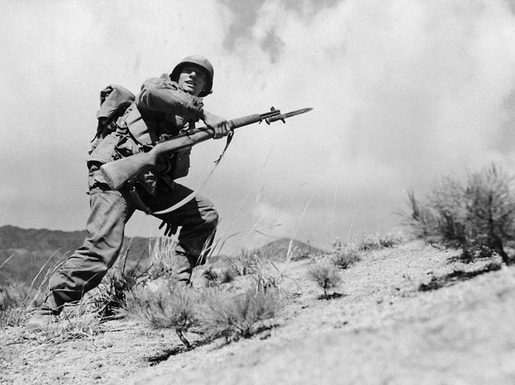
Taking the hill. Pfc. John J. Allen of Company E in the 25th Infantry Division leads his men in attack on the west central front in Korea, March 30, 1951.

How do we move innovation forward? We need to see this as a battle of hearts and minds, of overcoming dogma and fixed mindsets, using skirmishes to advance the innovation advancement. We need to break out of entrenched positions and lead innovation forward.

Many people feel innovation is an uncomfortable place, it often is at the edge, it deals in both opportunity and risk, it is uncertain to commit to joining the innovation battle. Sadly the majority working within our organizations do not understand innovation, it is too intangible, it seems shrouded in mysteries, yet it offers challenge, excitement and satisfaction. To achieve ‘something’ is highly motivating.

We firstly need to mobilize around innovation

To mobilize the organizations troops you have to give them objectives, they need to identify and be given a clear understanding of the ‘cause and its effect’. Over time they can recognize the positive effects and begin to understand the consequences if they don’t join in and engage.

Let me use a military metaphor, in war for this post.

Continue reading “Taking the hills, one at a time, for innovation advancement”