Seeing Your Innovating Future Across Different Horizons

The three horizons offer us much to frame our innovating future

IFD Mountain ViewFollowing a couple of recent posts on reflecting on the three horizons methodology, firstly here and then here, I wanted to come back to where I see real value, in managing your innovating future.

The 3H methodology enables us to look out into the future, across three different horizons that can manage the transition between the short, medium and long term in our innovation activities, something often badly lacking in most organizations’ thinking.

It allows us to gauge the challenges, adding aspects we are beginning to gain a sense of, transitioning from one position to another. It allows us to deepen our evaluation of the innovation portfolio of activities, resources and skillsets across different delivery frames of the short, medium and longer term.
Continue reading “Seeing Your Innovating Future Across Different Horizons”


Three Horizons – fields of future, full of foresight.

Three Horizon Book Bill SharpeI’d like to relate to parts of a book that came out in late 2013 from Bill Sharpe, actually more a booklet, called “Three Horizons: The Patterning of Hope”, published by Triarchy Press, has some really helpful insights that is truly fields of future, full of foresight.

In this book, Bill outlines his distinct ways of creatively working through many of the unknowns, by framing and connecting through the Three Horizons, (3H) as his contribution to the patterning of hope for all our futures.

I draw out a lot from his thinking, experiences and approaches within the book. Some of these initial thoughts outlined here, re-affirm my own thinking and focus on the 3H, specifically for innovation and its management.

Here are some of the ‘triggers’ I connected with strongly from his book:
Continue reading “Three Horizons – fields of future, full of foresight.”

Reflecting on the Three Horizon Model for our Innovatation in the Future

Business as usualThere is that prevailing sense that we are just managing the business, as usual, leaving many increasingly uncomfortable and feeling exposed to concerns over innovation in the future. Why?

Our businesses are not adapting fast enough to changing conditions in the market, often lagging in the competitive race to update and keep relevant.

Businesses are struggling with conflicting knowledge flows and incoming intelligence, just simply managing their talent to keep them relevant, engaged and outwardly orientated.

They need to constantly adjust and adapt to the demands and challenges within the societal conditions, environments and markets, grappling with constant shifts in consumer demand and coping with the declining natural resources and what all of this might mean.

We are often short on foresight and certainly struggling with growing complexity.
Continue reading “Reflecting on the Three Horizon Model for our Innovatation in the Future”

Asset Orchestration is Required for more Dynamic Innovation

to orchestrate 5We all should recognize the incredible power of orchestration that is needed in innovation to bring the initial idea into a final successful commercial concept.

We have an ongoing need to create, extend and modify resources constantly and to achieve this we need to orchestrate and enable those resources to exploit and execute our innovations.

We need to ‘asset orchestrate’.

One of our blind spots is perhaps the focus on pursuing and organizing around innovation just within an organization and not being as aware of all that is externally going on around us.

There are continued and rapid shifts taking place outside the walls of our organizations, constantly occurring and changing, often it becomes a ‘race’ between spotting an opportunity and executing on it before your competitors do, or the market further moves on and it becomes a lost opportunity to have exploited.
Continue reading “Asset Orchestration is Required for more Dynamic Innovation”

Are you dependent on other’s best practices?

best-practices
I often wonder if “best practice” is actually a hidden drug within our organizations that everyone simply craves to be taking.
Why do so many advisory organizations promote best practices? Simply because those in the organization constantly feel under pressure to demonstrate why they are falling behind or keeping ahead of their competitors.
They crave knowing best practices, but tell me what really is the best practice of others really achieving?
If you are behind, best practice informs you and you go into a frantic mode to try and catch up. By the time you have achieved the best practice, it is simply out of date as those practising this have most likely moved even further on.
Continue reading “Are you dependent on other’s best practices?”

Exploring the Value Of Your Innovation Capital

Innovation Capital
Following on from my last post of “Place your future bets- invest in Innovation Capital” which outlined the significant contribution innovation capital plays in our economic growth and value enhancement, let’s explore some more.

Let me offer some further thoughts on its value to really capture and understand, so we can measure it within our organizations.

We have the three components; of physical capital, knowledge capital and human capital that are the innovation-related assets, these make-up Innovation Capital.

I have been arguing that innovation capital draws from the core of intellectual capital and its suggested (and broadly recognized) components of human, structural and relational capitals or social capital.

I have previously discussed this converging up, as the ‘nesting effect’
Innovation capital needs assessing and measuring so we can understand the relationship between these innovation capitals (and their present and future potential) and organization performance. We need to know the innovation capital ‘stock’.

Why, well ‘stock’ can be ‘static’ and we need to make this more ‘dynamic’ so innovation can ‘flow’ from this constant renewing of our capitals and be transformed into new value.
Continue reading “Exploring the Value Of Your Innovation Capital”

Place Your Future Bets – Invest In Innovation Capital

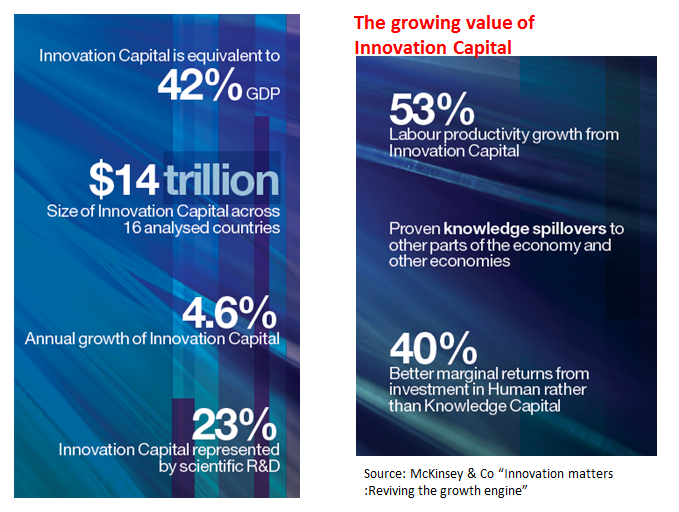
Value of Innovation CapitalRecognizing the value of our innovation-related assets is where the smart money should go, and then we need to invest in innovation capital. To gain growth and improve productivity is through innovation. We need to translate knowledge into new values.

When you pause and consider the make-up of Innovation Capital you realize it makes such an economic contribution and in a report from McKinsey & Co, they have set about identifying this to produce the above summary, covering 16 countries, to understand the real value of this Innovation Capital.

These numbers are big and still don’t fully capture everything associated with innovation as much remains ‘hidden’ or ‘attached’ to other activities as well.
We need to shift our thinking on what makes up Innovation Capital
Continue reading “Place Your Future Bets – Invest In Innovation Capital”

Building upon four key wealth creating pillars

Wealth creation 1Most rooms we enter have four sides and are traditionally built on a standard four-pillar design; they provide the structure to build upon.

Presently in many of our economies, particularly in the West, we are struggling to find real growth; we are limited in our wealth-creating possibilities.

Why is that? Our structures seem to be weak, not strong. Continue reading “Building upon four key wealth creating pillars”

Exploring Diffusion and Adoption for Innovation – Part 3

Dealing with DarwinThe future within our engagements will determine diffusion and adoption- part three

One of my favorite books is “Dealing with Darwin– how great companies innovate at every phase of their evolution” written by Geoffrey Moore. It is well worth a read.

When you work through his other books and connect thinking of “Crossing the Chasm” and “Inside the Tornado” you really appreciate the learning stories coming out of Roger Moore’s studies of the Technology Adoption Life-Cycle.

We all need to rethink a lot as the new challenges come rushing towards us.

In his work, Geoffrey Moore talks about ‘traction’ and I think this is a great word for thinking about how to gain diffusion and adoption in product, service or business models, to gain market and customer acceptance.
Continue reading “Exploring Diffusion and Adoption for Innovation – Part 3”

So what is holding innovation back? A new GE report

GE Global Innovation Barometer 2014I always look forward to the GE Global Barometer and the 2014 report is no exception, actually it really has moved the needle on what is presently holding innovation back.

The Barometer has explored the actions or constraints that senior business executives are worrying over in their pursuit of innovation.

The fieldwork was undertaken in April and May, 2014 and covered 3,200 phone interviews to people directly involved in the innovation strategy or process. It covered 26 countries and was conducted by Edelman Berland on GE’s behalf.

The supporting website provides the GE view of how this report reflects and provides an overview, an interactive, resources and key point headings sections to explore.

I  personally think GE have actually been a little too low-key on this report and frankly far too conservative on the potential takeaways in reading their ‘take’ in the overview.

It has significant implications for our organizations to grapple with but each is certainly not alone, it is a collective need to move innovation forward or you place much at risk if you don’t find solutions to the issues raised in this report.

This year the Barometer broke out of its past and steamed ahead.
Continue reading “So what is holding innovation back? A new GE report”