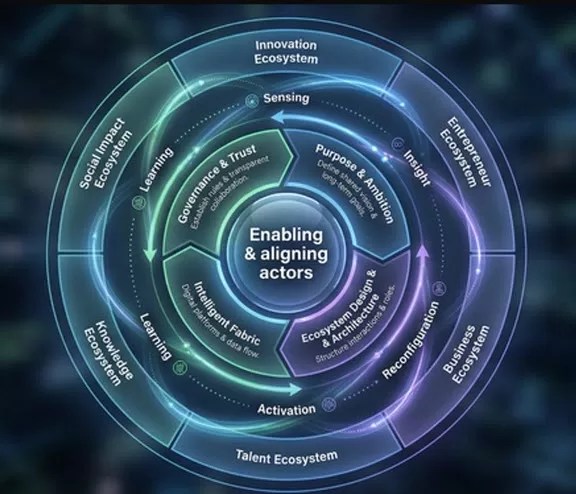
Are our initiatives delivering all the value they could?
This time of year is always demanding — year-end reviews, next-year plans, and the pressure to show tangible impact from so many ongoing initiatives. Perhaps this year, uncertainty feels even sharper.
AI pilots, innovation programs, sustainability efforts, and partnerships are advancing — yet too often in isolation. The result: value potential left on the table and a missing sense of cohesive advantage.
Across many conversations, a common refrain keeps surfacing: initiatives are multiplying, but integration is lagging. It is Integration, not invention, now determines adaptability and return.
My research on Ecosystems is throwing up some revealing issues, briefly
Feeling trapped, break out of the box with Dynamic Business Ecosystems
From Meta-Framework to Dynamic Modular Architecture: Why Ecosystem Thinking Must Now Become Practical.
After the launch of the Integrated Interconnected Business Ecosystem (IIBE) in September providing a blueprint to understand and build out Ecosystem thinking and design, the past four weeks has moved the “what” as well as the “why of Ecosystems into the essential “how”. This takes Ecosystems into the operational stage.
For me, it has been thrilling to evolve this thought process through some amazing intelligence from multiple advanced AI chatbots to brainstorm, validate, question, code and provide in a level of persistence in all the avenues I needed to explore and validate.
This work has achieved a realisation. We have moved to the operating level with IIBE-DMA
Connected Business Ecosystems for Impact and Value
Organizations are facing more tension than ever. They recognize ecosystems are critical but are frozen in different levels of uncertainty- be this investment fatigue, short-tern ROI pressures, internal misalignments abound, the enourmous pressure of AI and what it replaces, challenges or disrupts, and the fear of being confronted by larger scale transformation at times of economic uncertainly.
The last thing most do not want to hear is about another new comprehensive, transforming business model like the Integrated, Interconnected Business Ecosystem (IIBE) blueprint can offer. I get that but this needs to be also viewed through different eyes.
The IIBE offers a pragmatic solution staged over time. Its central premise is actually managing its orchestration, providing this progressive ecosystem alignment, enabling a shift and adaption into Ecosystems at their “given” pace and appetite.
The IIBE blueprint helps organizations to advance at their capabilities and capacities placing this integrated ecosystem thinking, into existing strategy, operations and partnerships- without requiring disruptive transformation. It works with current business models, it builds coherence across existing initiatives and reduces complexity in stages of learning and proof.
The IIBE operates as an alignment tool not intent on delivering a transformation agenda, unless it is necessary due to crisis, recognized need of how ecosystems can reconfigue new markets and competitive advantage as the necessary new competitive edge reguired.
So How Can Organizations Move Forward without those Grand Transforming EverythingApproaches?
During September 2025 I launched the Integrated Interconnected Business Ecosystem (IIIBE) supported by fifteen posts giving different levels of explanation, validation and understanding.
In recent days I conducted an initial audit of this and I used Chat GPT, Google Gemini and Claude to make their assessments. I was surprised by the significant differences each provided back. There were “thumbs up” for the explainers and the comprehensive framework with specifc mention of:
Narrative arc that offered logically: problem framing → core dynamics → structural decomposition → orchestration & intelligence → value-shift to co-creation → business model implications → call to action. Readers can follow the progression.
Concept clarity for specialists. Terms like dynamic ecosystem, orchestrator’s engine, adaptive core, and value co-creation are consistently defined and cross-referenced across posts. That builds credibility.
Depth and rigor. There’s substantive decomposition (pillars, dual layers, intelligence layer) — which signals this is more than buzz. Good for an audience that values frameworks and thinking tools.
The importance of Governance requires a constant Evolution for its Dynamics
Ecosystem governance isn’t a static set of rules applied once, but a dynamic, evolving process that adapts as the ecosystem matures. It absolutely is a living, central building block.
To structure this out and convey its dynamic nature, we introduce The Adaptive Ecosystem Governance Lifecycle Framework. By framing governance as “an adaptive lifecycle” and building out the core pillars of Dynamic Governance, this framework offers a unique perspective.(This is a repost to bring this into the IIBA Launch due to its essential position.
Viewing Governancein within a lifecycle approach with suggested Governance Mechanisms to be included at each stage, makes a significant difference in how you manage this within any Ecosystem thinking and design, ensuring it evolves precisely with the journey you are making.
The Integrated Interconnect Business Ecosystem Approach
Since my launch of the Integrated Interconnected Business Ecosystem framework on 3rd September 2025 I have been busy exploring the many parts of this. Counting this post I have provided FIFTEEN explainers of this IIBE from its evolution, rationale into its many component parts
So why? No, not why so many posts written, let alone in one month, but all the necessary explaining of this blueprint. I think this is needed for all of its connected value and guidence to a area of design that offers a comprehensive approach to managing and building Business Ecosystems. For many, Business Ecosystems are a bit of a mystery so I needed to unravelling this in a “collective burst” of explainers
Of course its strength or value is determined by those who want to explore this thinking and design, wanting to explore its potential for their business. It is built for integrated and interconnected growth, impact and providing the building blocks to build and deliver unique business propositions for your business. Click here to contact me so we can begin to talk over your needs
So in this post it is offering a (simple) communication guide for the much needed multi-stakeholder engagements this is aimed at. So “hear ye, hear ye- one and all, here is the why it offers value to you.
Opening up the Mind to Connected Ecosystem thinking
During this month of September 2025 I (finally) launched my comprehensive approach to Integrated Interconnected Business Ecosystems. It has all somewhat come out in one big rush. Fifteen posts in one month (!) but I took the view this needs explaining, exploring and expanding the thinking that went into it over a long learning and research period.
Moving from a business largely based on linear thinking is really hard to master initally. It takes a real mindshift and commitment to understand the why, how along with the what and when, and then where to apply this within your business, to explore and then learn for expanding it across the organization.
Nothing happens overnight, it does take a structured learning and implementation plan. It takes a dedicated approach of learning and experimenting.
Ecosystem Business Model Dialogue and Discovery sample results
The most powerful business ecosystems don’t just optimize within traditonal industry boundaries- they deliberately span across them, creating unique values in the different intersections that traditional models can’t access.
Above is an lllustration of a outcome assessment of a dialogue and discovery canvas proving area or gaps that need additional discussion between the partners within the Business Ecosystem.
When building out my Business Model Ecosystem I mapped out 69 components across Strategic, Operational and of real importance the Cross-Cutting elements, firstly to single these out and also assigned them to the relevant building blocks of the dialogue framing and discovery canvas.
In this post I am focusing on the cross-cutting components and why they are so valuable
When you set about proposing a new Business Ecosystem framework you do need to back this up with a lot of evaluations and assessments tools, to explore readiness, maturity and determination, identifying the gaps that need to be bridged or overcome in additional resource or added partner requirements.
My business ecosystem thinking comes from three essential areas of focus over the years.
Innovation and Creativity, in all its forms and stages I have been advising upon now for twenty plus years- it has changed but not enough, still a little too manual, disjointed and so often never achieving the early promise perceived in ideas or concepts and I needed to shift perspectives.
I moved more to recognizing Innovation Ecosystems as offering a better “connected outcome” as they leveraged open innovation and brought outside collaborations far more into the solutions being persued. Innovation Ecosystems give a more distinctive business proposition and value.
The recognition of Dynamic Ecosystems came as another area of focus, the recognition of the dynamism needed and the adaptability and reslience to be built into the journey and eventual solutions.
I arrived at Business Ecosystems in 2016 to make it increasingly central to my work and offering going forward. This post explains the building up of my Business Ecosystem work, specifically on building out a Business Model Ecosystem (canvas) and what it needed to underpin input and outputs to then validate and build (potential) outcomes.
Signal Amplification finding new sources of Value Co-creation
We are all in need of moving towards faster and bigger buying of valuable solutions that reduce complexity and provide improved outcomes over the existing ones.
How do we qualify opportunities in the future (AI, Human and in what order) to get to value points of different opportunities. How do we see the future of value consumed? What does value look like and in what new forms will this value be delivered?
Much will come from our adopting Ecosystems in design and thinking, providing the orchestrators environment where those within that orbit will see and build in co-creation ways and then position themseves with that business ecosystem as the center of the new mass to build it and constantly improve its interconnected, integrated parts.
Ecosystem opportunity sensing and capture where speed of qualification and the shape of the value ar going to change dramatically comes from determining a different way of working.