Recognizing Root Cause of Innovation Failure

Root Causes of Innovation Failure

So what are root causes of poor innovation performance?

Following a series of surveys by BCG ( www.bcg.com ) a few years back, they argued there was a clear emerging need to resolve specific ‘weaknesses’ in the innovation practices of clients that are impacting the ROI and driving down innovation performance.

How can you fix the root causes of these? We have some clear thoughts and would be happy to discuss these with you.

Here are my thoughts on the root causes of failure

Key concerns that impacted innovation provided from these surveys were:

  1. Lengthy development times
  2. A risk-adverse culture
  3. Difficulty selecting the right ideas to commercialize
  4. Lack of internal and international coordination
  5. Poor enforcement of time lines & milestones
  6. Limited measures and metrics to understand performance
  7. A lack of organizational alignment
  8. Dissatisfied with return on spending

Squandered opportunities need targeted improvement

  1. Learning to balance risks
  2. Focusing on time frames more
  3. Seeing returns across the portfolio of projects
  4. Earmarking sufficient funds
  5. Partnering effectively with suppliers and others
  6. Fostering a climate of innovation that promotes.
  7. Deepen the understanding of customers

Outcomes needed to be resolved

  1. Moving quickly
  2. Enforcing time lines and milestones
  3. Balancing risks and returns across the portfolio
  4. Obtaining input from across divisions and geographical areas
  5. Securing early commercial involvement
  6. Earmarking sufficient funds and appropriate resources
  7. Providing strong support to the project teams  

Hurdles tend to lie at different stages of the innovation process (industry specifics examples but certainly not exclusive to these only)

  1. Idea selection (mainly technology and telecoms)
  2. This lack of clear insight into customers (manufacturing)
  3. A shortage of great ideas (consumer products)
  4. Inability to get across, market and publicize innovation (Auto)
  5. Moving ideas to cash
  6. Time-to-market, time to volume

The triple bottom line: speed, discipline, enforcement
Defining the CIO’s role

What’s sits in the CIO’s Role? What makes up the Chief Innovation Officers agenda?

The setting of the principal innovation officer’s agenda is critical. This checklist provides the platform to build from. Interested to hear our views more on this?

I believe we have the ‘content’ that fills this out from an agenda into a activity and action orientated building process.

We conduct this in a mentoring, advising stance so it is paced to the person and the unique challenges they face

Within the CIO’s role are structuring the activity around:

Organizational capabilities: evaluate and access the company’s innovation capabilities, working through the culture needed for innovation; removing the barriers to innovation

Competencies: make everybody’s job to grow the organization for innovation and renewal

Breakthrough strategies: develop insights and fresh thinking, tools and techniques that enable the creation of strategic innovation

Business models: explore business model design; build the business case to accelerate, change and (radically) alter the existing state

Opportunities for growth: create new value, disruptive and radical innovation; identify new markets and products; hone incremental value; build bigger and better ideas that solve customer need

Catalytic thinking: Innovation can be the catalyst to a set of strategic questions, providing new perspectives; making different connections that lead to growth opportunities

Best practices: have the latest insights on trends and approaches that can alter existing thinking

Lifecycle management: organize around different platforms, portfolio’s and approaches to enhance the value of the investments made. Pinpoint, verify and improve the impact that innovation can bring to the different stages of development

Accelerate change: critically explore speed-to-market,   execution, alignment, stretching and scaling; create more fluid structures, asset utilization to enable innovation

Enhance intellectual thinking: leverage the intellectual assets and the intangibles by enhancing knowledge sharing and conversion strategies for improved deliverables and worth

Strengthen collaboration: enable new forms of networking, collaboration and relationship management techniques that can broaden possibilities, reduce tensions and accelerate agreement on projects

Lead clearly: develop insights into the role of top management and how innovation processes can be developed and embedded through coaching, championing and facilitating; turn aspiration into reality

Source: Paul Hobcraft, Agility Innovation

Building the Innovation Business Case

The building always the Innovation Business Case offers a unique approach to tackle one of the real problem areas within innovation- making the case compelling.

One of the toughest aspects within Innovation is making the Business Case. Much of the information is imperfect, the returns are often fuzzy and the doubters ready to block and deter new ideas from entering the commercialization process.

Knowing the issues, reducing often the ‘noise and distractions’ and making the professional case is what we need to do to attract commitment to the projects we are working upon.

How can you reduce down uncertainty? By ensuring the innovation business case takes a clear methodical approach to this and builds the arguments up in a sound structured way, that shows the areas of clear discussion and conclusion and reduces down the more ’emotive parts, so as to allow the ‘idea or concept’ to firm up and be seen for its real merits.

So what is the approach taken?

A systematic model that you go through, that takes the business case through a structured step-by-step approach, enabling arguments based on facts to build and grow, to lay out challenges and uncertainties, so everyone involved can see the same steps of approach in making the case.

The business evaluation obtained provides a consistency of approach to all cases irrespective across the organization to build a compelling comprehensive case building technique that provides all stakeholders their essential information through a clear transparent process.

  • Offering different creativity tools to start the process, structuring project information on a comparable basis, clarifying often different definitions of success, providing suggested guidelines to individuals making the case, exploring different aspects of ‘getting ready’ to make the case and what that means and points to where to go to resolve these.
  • Then we move into building the business case preparation, cost and benefit analysis, clarifying opportunity need, factor analysis, assessing stakeholder interests, clarifying uncertainties.
  • The next group of factors to consider is making the clear assessments of competition, outlining the tactical moves to be considered market attractiveness, the ability to execute and what business model does the business case take to provide the fit and attract the commitment.
  • Lastly to go back through the Business Case elements check-list to present a format that builds up and breaks down the case logically with the best available inputs, the unique selling proposition and the future resources needed to translate this case into a winning commercial prospect, with clear time lines and milestones and the projected financial and commercial value it would provide.
  • Moving an idea into a mainstream activity is one of the hardest aspects to achieve. Making the innovation business case a winning one is not down to luck, it is down to a systematic approach to building up the compelling case for this. Making the innovation case in a well-structured process gives greater opportunity for identification and realization.

This approach we take offers a comprehensive solution to the innovation business case and its methodology and it belongs to its owners Agility Innovation Specialists. To find out more contact us on


Examination Mapping

Examination Mapping gives different perspectives vital to the innovator to appreciate and map the value aspects of those expectations.

So getting to know the health of anything usually requires some rigorous examination and the potential within the new innovation concept needs some evaluating.

It is no different for understanding your innovation fitness. We explore fitness in many ways and some of these approaches are unique, exciting and ‘dynamic’.

Any examination needs to follow a ‘routine’ methodical check up. In our view any initial innovation examination requires to explore four key ‘health’ indicators

1. The ‘fit for purpose‘ in strategic and innovation intent, definitions of success, the core values, sense of mission .
2. What are the expectations and the environment you chose to compete in3. What condition of ‘readiness’ in design, capabilities and capacity4. Have the critical processes for creating success been laid in or still have critical gaps

The outcome are your initial examination results? These form the ‘way forward’ in discussions, resolution and design.

So what is the approach taken?

A systematic model that you go through, that takes the business case through a structured step-by-step approach, enabling arguments based on facts to build and grow, to layout challenges and uncertainties, so everyone involved can see the same steps of approach in making the case.

The business evaluation obtained provides a consistency of approach to all cases irrespective across the organization. one to build a compelling comprehensive case-building technique that provides all stakeholders with their essential information through a clear transparent process.

This should include consideration for the following within the preparation and assessment:

  • Offering different creativity tools to start the process, structuring project information on a comparable basis, clarifying often different definitions of success, providing suggested guidelines to individuals making the case, exploring different aspects of ‘getting ready’ to make the case and what that means and points to where to go to resolve these.
  • Then we move into building the business case preparation, cost and benefit analysis, clarifying opportunity need, factor analysis, assessing stakeholder interests, clarifying uncertainties.
  • The next group of factors to consider is making the clear assessments of competition, outlining the tactical moves to be considered market attractiveness, the ability to execute and what business model does the business case take to provide the fit and attract the commitment.
  • Lastly to go back through the Business Case elements check-list to present a format that builds up and breaks down the case logically with the best available inputs, the unique selling proposition and the future resources needed to translate this case into a winning commercial prospect, with clear time lines and milestones and the projected financial and commercial value it would provide.

Moving an idea into a mainstream activity is one of the hardest aspects to achieve. Making the innovation business case a winning one is not down to luck, it is down to a systematic approach to building up the compelling case for this. Making the innovation case in a well-structured process gives greater opportunity for identification and realization.

This approach we take offers a comprehensive solution to the innovation business case and its methodology . To find out more contact me.

Jobs-to-be-done

The Jobs-to-be-Done

There are many jobs-to-be-done when you begin to work through innovation. It is knowing which ones have the real value in them

To build and sustain innovation you need to think through many. Here we provide a handy reference to what and where we need to seek out innovation and for each of these we have specific solutions, frameworks or approaches.

  1. Building innovation capabilities: evaluating and accessing the company’s innovation capabilities, working through the culture, climate and environment that are needed for innovation, removing the barriers to innovation to increase the potential available.
  2. Developing the competencies and capacities to innovate: make innovation everybody’s everyday job; to grow the understanding and organization for innovation and often for the renewal that is needed.
  3. Creating breakthrough strategies: insights and fresh thinking, tools & techniques that enable the creation of new strategic innovation, discovery, exploring white space, extending beyond the existing core to turn thinking into real world solutions.
  4. Developing new business models: exploring different business model design and innovation. Building the business case to accelerate, change and (radically) alter the existing state in greater valued ways.
  5. Finding opportunities for innovation and new growth: create new value, disruptive and radical innovation, disrupting the market to create new growth, identifying and developing new markets and segments, optimizing new products, honing the incremental value, building bigger and better ideas that solve the customer need.
  6. Catalytic thinking: Innovation can be the catalyst to a set of strategic questions and problems, providing a new scope through innovation, shifting perspectives and mindsets, making different connections that lead to growth opportunities.
  7. Knowing the emerging, leading and best practice of innovation: having the latest insights, awareness and understanding of trends and approaches through innovation and what this can possibly bring to existing thinking.
  8. Recognizing innovation lifecycle management: organizing around different platforms, portfolio’s and approaches to enhancing the value of the investments made. Pinpointing, verifying and improving the ‘impact’ innovation can bring to the different stages
  9. Accelerating and bringing change: critically exploring speed-to-market, execution, alignment, stretching and scaling accordingly, more fluid structures, asset utilization, using innovation as the positive change agent/ enabler.
  10. Enhancing the quality of inventive intellectual thinking: leveraging the intellectual assets and the intangibles by enhancing knowledge sharing, transferring and the conversion strategies for improved deliverables and worth.
  11. Strengthening the collaborating effect: through a growing need for greater networking, collaborations and changing relationship management techniques to broaden horizons and possibilities, reducing tensions and accelerating agreement and opening up more informal innovation pathways.
  12. Building innovation resources: access to concepts and theories, tools, templates, techniques and methodologies, research, inspiration, knowledge insights and critically links to related activities that feed off of innovation.
  13. Leading clearly for innovation: insights on the role of top management and how innovation processes can be facilitated, developed and embedded through coaching, championing and facilitating. Turning aspiration into reality.
  14. Management 2.0: is about reinventing innovation management for a new age, management model innovation, and management of innovation activity in general. Building innovation into the very fabric of the organisation.
  15. Long – term innovation:  the ability to embed a ‘sustaining innovation’ mindset, develop the environment for independent thinking and longer-term identification, seeking out tomorrows pathway through a more holistic view, growing more dependency on increased interactivity.

This can look like a formidable list of the ‘jobs’ but we believe the structuring of these can be well laid out with our help and insights.

The Three Horizon Methodology

Seeing beyond the current horizon

 Thinking in different horizons prompts you to go beyond the usual focus of fixing innovation just in the present. The Three Horizons Methodology connects the present with the desired future and identifies the ‘seen’ disruptions which might occur in moving towards a vision.

This first emerged in the late nineties through the work of Baghai, Coley and White (1999) and has been further developed by a range of practitioners such as Andrew Curry, Anthony Hodgson and Bill Sharpe (2008) and the International Futures Forum, based in Scotland.

This methodology lends itself well for mapping out the different horizons needed for innovation, the discipline I focus within. It offers a helpful way for connecting your innovation activities over different horizons and managing uncertainty in better ways.

Exploring the Three Horizons

We need to clarify how to identify the existing prevailing or dominant system and the challenges to its sustainability into the future, i.e. the case for change (horizon 1). Innovation can lose the ‘fit’ aspects over time as the external environment changes.

We also need to think through the desirable future state, the ideal system you desire and the emerging options . Those that can displace what you already have. Often you can identify elements in the present that give you encouragement(horizon 3); keeping yourself open to all options that could lead to transformational change.

Often the struggle is to draw out the nature of the tensions and dilemmas between vision and reality, and the distinction between innovations that serve to prolong the status quo and those that serve to bring the third horizon vision closer to reality (horizon 2); This is the space of transition, often unstable, called the intermediate space where views can collide and diverge.

When you innovate do you consider the following?

  • Innovations that improve your current operations?
  • Extend your current competencies into new, related markets ?
  • Change the nature of your industry ?
  • How do you managethe different time dimensions on innovation?
  • What can help reduce the uncertainty dimension associate with the unknowns of innovation not yet seen?
  • There is always an innovation “zone of uncertainty” as the future never stays the same- how do you address this effectively?
  • How can you capture the options to allocate the necessary resources behind these?

We so often struggle to articulate our innovation activity and then can’t project our plans into the future in consistent and coherent ways. If this ring’s true for your innovation activity in your organization, then it is in danger of being seen as isolated; one-off events that fail to link to your organizational strategy for the longer-term. Furthermore you’ll be missing, or not capitalizing on, emerging trends and insights where fresh growth opportunities reside.

The 3H framework offers a perspective that accepts the need to both address the multiple challenges that occur in the first horizon, foster the seeds of the third and, allocate appropriate focus and resources to manage the transitions from one to another.

What makes the model valuable to innovators is that it ‘accepts’ that competition is restless, markets are evolving and dynamic and that change is a constant. The three horizons approach offers the methodology for constructing plausible and coherent innovation activities projected out into the future. It looks for emerging winners.

This is not a planning tool; it is providing a valuable evolutionary perspective that dialogues can be formed around so decisions on where to focus and what resources to apply can be made on a more plausible and coherent set of activities projected into the future, searching for emerging winners that can change and challenge your existing business.

You learn to map your innovation future across the three different horizons

Mapping Fitness Landscape Dynamics

By exploring and modelling the mutual dependencies you get to see how the existing and alternative future innovation system will behave as you begin to map out and recognize the different emphasis points that make up your innovation system.

You can begin to identify what are the more important dynamic ones that require a more dedicated focus and placing more of your resources behind, while others can evolve at their own pace or simply improve as they are far more dependent on the dynamic ones than you realized initially. These can get simply get ‘pulled along’ and rise equally in their performance.

For me knowing your dynamic innovation landscape and all of how it interrelates has such a re-generating force to propel innovation forward.

There is a complementary set of forces; improving one often triggers improvement in another. What you have to guard against is possibly ignoring one might equally impact negatively on others. Recognizing dependencies is critical and their triggering effect makes innovation evolution even more dynamic.

We are looking for the ‘combination’ effect of a dynamic set of capabilities and competencies that generates improved performance. The issue is to know what and which ones?

The combination effect to gain a greater innovation fitness effect comes from managing this over four stages of the journey of innovation fitness towards the dynamic capabilities stage and fitness landscape outcomes.

The four stages will be described in more detail in the discussions but briefly are:

  1. The goal within these stage is to identify the key dependencies relevant for improved innovation within your organization to discover
  2. What are the mutual dependencies that will have a more dynamic impact on your innovation system so you understand
  3. What consequences come from this and how the changing environment will behave so as to consider the effect, that then leads to
  4. What recognition and implications this has so as to put in place an ongoing, evolving set of innovation dynamics that keep you fit to perform innovation on a sustaining higher performance basis.

Again I want to emphasis here, this is an evolving journey but the critical recognition here is, for innovation to continue to be the driver of future growth and wealth, it clearly does need to have a greater understanding and recognition of its management potential within organizations.

This site www.innovationfitnessdynamics.wordpress.com is determined to push beyond today’s accepted, often ‘lagging’ performance from innovation activity, and raise the innovation performance engine up within organizations. I feel we do have this critical need to have in place a growing clarity of the factors needed to consistently deliver a more ‘leading’ position of knowing what does actually have a real dynamic impact, both on an organizations innovation performance and the individual contributions that contribute towards the required strategic goals and objectives.

This I feel states our journey and how we are planning this out to traverse across the terrain towards better innovation solutions, that make up the dynamics of innovation and provide a ‘fitness’ solution that is unique to your needs. Care to share and join the journey?

Managing Along the Pathway Curves

The approach we take to embedding innovation in all its forms is a unique one that we have called the Innovation Pathway Curve:


We take you through FIVE of these curves in learning and exploring:

  • Overcoming the different stages within the obstacle curves
  • Building the necessary capability and capacity curves
  • Developing the growth building steps within the curves
  • Exploring the organizational impact understanding
  • Delivering the discovery & transformation needed.


Our methodology takes you through a structured approach, a way of climbing up this innovation understanding curve so the different needs you are trying to achieve (incremental, distinctive, radical, & disruptive)  can be managed in a clear ways, to support any initiative.

Innovation needs to be worked at, so as to continue to grow a deeper understanding of its ‘make-up’ over time. You gain from this pathway approach a deeper understanding of all the aspects of innovation needed as well as our approach supports experimenting in controlled environments to take these fully on board, embedded and practised as part of the curve methodology.

At Agility we can help you to understand and be effective on your own innovation curve understanding in the ‘fits’ needed and why the different components do need to come together to deliver the value required from innovation today.

To find out more please contact us directly to discuss how this can be effectively put to use in your organization to grow your innovation curve understanding dramatically

Leadership Alignment Work Mat for Innovation

Leadership Alignment Work Mat for Innovation to be fully connected.

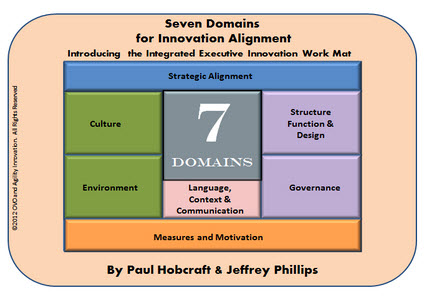
The Leadership Alignment Workmat provides a unique examination of the executive’s role in innovation.

This offers a framework that the leadership of the organization can adopt to ensure linkages and synergies between strategy and innovation, innovation and capabilities, innovation and culture.

Often they lack the communicating medium to help clarify and shape the innovation story to tell, so as to provide the guidance necessary for achieving that essential engagement and encouragement they would like, to align organizational efforts required from innovation to the strategies envisioned.

Benefits of applying the Leadership Alignment Work Mat

From an investment in an executive work mat exercise you receive four significant benefits.

First, as an executive team you will create cohesion and a consistent innovation framework that reduces barriers or uncertainties for innovators.

Second, you demonstrate your engagement, which increases visibility and lowers risk, which encourages more and better ideas.

Third, you create work-flows and encourage innovation skills and capabilities which accelerate ideas through your internal processes that increase the opportunity to be more self-organized under this framework.

Fourth, you influence compensation, provide motivations and promote the cultural and climate to innovate which progressively reduces barriers and creates incentives for innovation to thrive.

These benefits add up to more speed, more agility, clearer flexibility resulting in new, relevant products and services that can increase organic growth and provide solutions that differentiate you.

We believe C.E.O’s and senior executives play a vital role in the success or failure of innovation. Unfortunately, those roles have often not been well-defined and sometimes they are rarely well executed. We call this the engagement- alignment gap. Only an engaged, committed senior executive can create the means for building a sustained innovation capability or disciplined approach through defining innovation’s role.

The Leadership Alignment Work Mat resolves the litmus test.

It provides a compelling structured approach for senior executives to build, extend and sustain an innovation capability. Starting with the most strategic goals of your business, it links and aligns innovation to strategy; it explores the critical aspects of any senior innovation strategic framework. It addresses the critical aspects so as to provide a holistic approach to innovation, reducing uncertainty, reducing risk and increasing your chance to help your company innovate consistently.

The end outcome of this Leadership Alignment Work Mat approach provides the innovation leadership and guidance to your organization to ‘frame’ the innovation activity to your strategic goals. This allows you to articulate and communicate the alignment through the innovation work mat throughout the organization. It will provide the necessary understanding needed to perform the innovation tasks more effectively under this framework umbrella.

It offers the strategic ‘frame’ your innovation future requires, it forms the emerging common language and communication necessary across the organization, that provides guidance, inspiration and clarity to your innovation vision and goals.It allows innovation to ‘cascade’ throughout the organization to achieve that close alignment innovation requires with the strategy to achieve a meaningful and sustaining set of results.

To find out more or request a detailed White Paper on this, please contact  paul@agilityinnovation.com

Achieving Real Intensity of Purpose

Sustaining an innovation competitive advantage- a unique formula

Sustaining innovation is made up of critical components that bring intensity and return to your investment and provide you the framework to build a sustaining advantage on innovation others will find hard to imitate.

So what is this framework? SCA = II + EE + MLC + OC + RNE- its power comes from innovation intensity.


Sustainable Competitive Advantage (SCA) comes from the combining effects of the following:

II = Innovation Intensity – its degree of adoption, investments made, its multiple level of activities and the focus of the intensity given to building capabilities

EE = Entrepreneurial Energies – how you set about and promote and generate the internal environment to enable innovation to take hold and be seen as a learning environment people want to get involved with

MLC = Market Learning Competence – these give a clearer awareness on what and where to acquire from and learn from. The key need is to orientate always towards, and generally get to the heart of, where innovation takes place- in the market place and with your customers

OC = Organizational Capacity – knowing the differences in learning, linking the different intellectual capitals and combining the complementary assets needed to make them more dynamic

RNE =  Relationship & Networking Effects – the supporting and enhancing aspects of making greater connections, collaborations and exchanges so as to speed up the process of innovation, reduce costs and enhance understanding getting closer to knowing where latent knowledge lies to assist and share for greater impact and result.

What is the result of adopting the SCA framework?

ROI = Investment x Activity x Change (learning environment)

                                Results Impact


Making Sustainability central to innovation capability building

Today’s challenge is to build the capacity to be different, to sustain the critical aspect that innovation can provide: the stimulus for sustaining lasting growth. It is through continued learning, capabilities become stronger and more difficult for competitors to understand and imitate. Capabilities grow through use and application.

You aim to provide two types of capabilities, distinctive, which are the characteristics of the organization which cannot be replicated by others and reproductive, which can be bought by the competition but need to be appropriate to your objectives. It is through value creation you achieve greater sustainability and the five elements within this model can provide the path to this.

We offer a unique solution that intensifies innovation so it becomes the power for sustaining and driving your present and future growth.

Come talk to us over what ‘sits’ behind this framework to then apply it within your organization.